The best startup accelerators in Canada in 2026 mostly take no equity, most write no cheque, and two of the names still on other lists are not taking applications at all. That changes how you should choose. If the trade is your time rather than your cap table, the question is not which program is most prestigious. It is which one fixes your current bottleneck: technical credibility, customers, talent, or investors.
Below is the 2026 comparison: what each Canadian accelerator takes, what it gives, which stage it wants, and when you can apply next. Every term and date was checked against the program's own site in September 2026. Where a program does not publish a value, the table says so instead of guessing. Apply to the two or three that match your stage and sector. Skip the rest.
Canadian accelerators compared: 2026 terms and deadlines
| Accelerator | City | Stage | Cheque and equity | Next deadline or intake |
|---|---|---|---|---|
| Creative Destruction Lab | Toronto, Vancouver, Montreal, Calgary, Halifax | Pre-seed to seed | No cash, no equity, no fees | 2026/27 closed July 24, 2026. See site |
| DMZ Incubator | Toronto | Seed, with recurring revenue | No cash. 2.5% common equity | Rolling, fall and spring onboarding |
| Communitech Fierce Founders | Kitchener-Waterloo | Idea to $1M+ revenue | $30K–50K milestone funding (Intensive Track) | Interest form. See site |
| MaRS Discovery District | Toronto | Early to growth | No equity in programs. MaRS IAF invests day zero to seed | See site |
| Velocity | Waterloo | Idea to early stage | No equity. $5K and $25K pitch awards | Rolling |
| Next 36 | Toronto | Students and recent grads | No cash, no equity | October 14, 2026 |
| NextAI | Toronto | Idea to pre-seed, AI | No cash, no equity | Opens October 15, closes December 9, 2026 |
| Spring | Vancouver (virtual cohorts) | Impact ventures | Not published | See site |
| New Ventures BC | Vancouver, BC-wide | Early-stage BC tech | Competition: $110K first prize | 2027 not announced |
| Foresight Canada | Vancouver | Idea to scale, cleantech | Fees from $100/month | Rolling |
| Platform Calgary | Calgary | Launch to scale | Core programs free | See site |
| District 3 | Montreal | Idea to pre-seed | Free, no equity | Rolling |
| Innovation Island | Nanaimo | Early-stage tech and manufacturing | Not published | See site |
| Y Combinator (US option) | San Francisco | Any | US$500K: $125K for 7% + $375K MFN SAFE | Winter 2027: November 2, 2026 |
| Techstars Toronto | Toronto | n/a | Not running | No cohort announced |
| FounderFuel | Montreal | n/a | Last cohort 2023 | No open call |
The top tier: CDL, DMZ, Communitech
1. Creative Destruction Lab (CDL). Still the most selective program in Canada. It runs from Toronto, Vancouver, Montreal, Calgary and Halifax, plus sites in the US, Europe and beyond, with more than 20 streams across AI, quantum, health, climate, space and defence. No fees, no equity, no guaranteed investment. The model is objectives-based: mentors set you targets in two-month cycles, and companies that miss them are cut. Deep Genomics came through the Toronto AI stream, and Xanadu, which later closed a US$100M Series C, has CDL roots. Best for science-based startups with technical founders who can prove measurable progress fast. The 2026/27 cycle closed in July, so this is one to plan a year ahead for.
2. DMZ at Toronto Metropolitan University. The largest incubator in Toronto by volume, with 800+ startups that have raised $3.25B, according to DMZ. The Pre-Incubator takes idea-stage founders twice a year. The Incubator takes seed-stage companies with recurring revenue on a rolling basis, and it is the one well-known Canadian program that takes equity: 2.5% common, with no fees and no board seat. Alumni include Mejuri, Ada, Hostaway and Super.com. Pair this with our Toronto founder playbook.
3. Communitech, Kitchener-Waterloo. Less an accelerator than the operating system of the Waterloo ecosystem. Vidyard grew up here, and Faire sits among its member companies. Fierce Founders relaunched in 2026 for women and non-binary founders, and its Intensive Track offers $30,000 to $50,000 in milestone-based funding for companies working toward their first million in revenue. It also runs Go-To-Market and AI@Work programs. Mandatory infrastructure if you are building B2B software anywhere in the Ontario corridor.
Ecosystem hubs: MaRS, Velocity, Next Canada
4. MaRS Discovery District, Toronto. 1.5 million square feet in Toronto's Discovery District, now organised around life sciences, cleantech and emerging tech (AI, quantum, robotics, advanced manufacturing). MaRS says the ventures it has supported raised $10.6B+ between 2010 and 2024. Its evergreen fund, MaRS IAF, writes first cheques from day zero through seed and has put $93M+ into 180+ companies. ecobee (sold to Generac for up to US$770M) and Wattpad (sold to Naver for about US$600M) were both MaRS-supported. Best for health-tech and cleantech founders who need introductions more than curriculum.
5. Velocity, University of Waterloo. The most productive student accelerator in Canada. No fees and no equity, with applications taken on a rolling basis. The Velocity Pitch Competition awards $5,000 and $25,000 prizes, and Velocity Fund II, a separate venture fund backed by the university, writes cheques from US$25,000 to US$1M. Thalmic Labs (later North, acquired by Google) and BufferBox (acquired by Google) both started here, as did Kik. Best for student and recent-grad founders in deep tech or hardware.
6. Next Canada, Toronto. Three programs, none of which takes equity or puts in cash. Next 36 selects 36 undergrads and recent grads a year, and dropped its 2.5% equity requirement in September 2025. The 2027 cohort closes on October 14, 2026. NextAI is for idea-stage and pre-seed AI ventures with one business and one technical co-founder: applications open October 15 and close December 9, 2026. Next Founders is for growth-stage ventures and opens in January 2027. Next Canada says its alumni ventures have raised $5.7B. Alumni include Ada, Bridgit, Flashfood and SnapTravel.
West Coast programs: Spring, New Ventures BC, Foresight
7. Spring, Vancouver. BC's best-known impact accelerator, now running virtual Scale Ready cohorts and its Invest Together programs. Spring says it has supported 3,300 founders and catalyzed $81M+ in impact investment. It does not publish fees or equity terms, so ask before you apply. Best for founders building at the intersection of profit and purpose. If you are operating in BC generally, our BC startup ecosystem breakdown covers the wider landscape.
8. New Ventures BC, Vancouver. A province-wide startup competition that has run since 2000, not a cohort accelerator. The 2026 edition, its 26th, offered over $250,000 in cash and prizes, with $110,000 for first place, and wrapped in September. New Ventures BC says its alumni have raised more than $3.4B. The 2027 call has not been announced; the 2026 one opened in February. Best for BC-based pre-seed to seed founders who need positioning help before institutional rounds. If you are prepping to raise, pair this with our guide to raising pre-seed in Canada.
9. Foresight Canada, Vancouver. Canada's largest cleantech innovation and adoption accelerator, with 1,780+ portfolio companies that have raised $2.54B in venture capital, according to Foresight. It runs streams from ideation (Foundations, Kickstart) through commercialization (Launch, Pilot, Export) to capital (Investment Readiness, Foresight 50). Programs start at $100 a month rather than taking equity, and applications are open year-round. The domain expertise in carbon, hydrogen and grid tech is genuinely rare.
Prairie, Quebec and Island programs
10. Platform Calgary. A non-profit, member-based hub funded by the City of Calgary, the Government of Alberta, Alberta Innovates and the Government of Canada. Its core programs are free: Alberta Catalyzer for launch-stage companies and Platform Incubator, a 12-month program for scale-stage ones. A few extras, such as the CEO Roundtable, charge a fee. Best for B2B founders who can serve Alberta's core industries.
11. District 3, Montreal. Concordia's innovation centre. Programs run from Systems Mapping and Validation for idea-stage founders through Launch & Grow for companies preparing a seed round, and they are completely free with no equity taken. Your IP stays yours. Proximity to Montreal's AI research community is a genuine advantage for technical founders.
12. Innovation Island, Nanaimo. A non-profit that delivers Innovate BC's Venture Acceleration Program to tech, applied science and manufacturing companies on Vancouver Island outside Greater Victoria. Smaller than the urban programs, but it fills a real gap for founders who will not relocate to Vancouver or Toronto. It does not publish its terms, so ask.
The US option: Y Combinator
Y Combinator funds Canadian corporations again in 2026, after briefly dropping Canada in late 2025. The standard deal is US$500,000: $125,000 on a post-money SAFE for 7%, plus $375,000 on an uncapped MFN SAFE. The Winter 2027 batch closes on November 2, 2026. It is the one accelerator on this page that writes a large cheque on standard terms, and the one that will pull you toward San Francisco. Our Y Combinator in Canada guide covers when to flip to Delaware.
Not taking applications: Techstars Toronto and FounderFuel
Techstars Toronto. The Toronto accelerator went dark in 2024, after longtime managing director Sunil Sharma left, and it has not run a cohort since. As of January 2026, Techstars was recruiting a new managing director and completing fund formation, with a board drawing on Bell, ventureLAB, Peoples Group, the Axion Fund and Math Venture Partners. No hire or cohort date has been announced since, and Toronto is not on Techstars' list of open accelerators. For context, the standard global Techstars offer is US$220,000: a US$20,000 convertible equity agreement that converts to 5% common stock, plus a US$200,000 uncapped MFN SAFE. If you are building in the GTA, our Toronto accelerators and incubators list covers what founders there are applying to instead.
FounderFuel, Montreal. Led by Real Ventures and relaunched in 2023 with Panache and Inovia, offering $120,000 per startup over four months. Its alumni list includes Sonder, Mejuri, Unsplash and Transit. The 2023 cohort is the last one on record, and its application page still points to that deadline. Treat it as dormant until a new call appears.
How to choose in 2026
Three questions, in order.
What does the program actually provide? Capital, customer access, investor intros, or credibility. Most programs claim all four. Most deliver one, maybe two. CDL delivers investor access and technical credibility. Communitech delivers talent and enterprise customers. Y Combinator delivers a cheque and a US investor network. Pick the program whose real strength matches your current bottleneck.
Does the sector focus match? A fintech founder at a cleantech program gets thin mentorship. A hardware founder in a software-heavy cohort gets advice that does not apply. If you are pre-committing to a US market, read our post on Canadian founders pitching US investors before you apply anywhere.
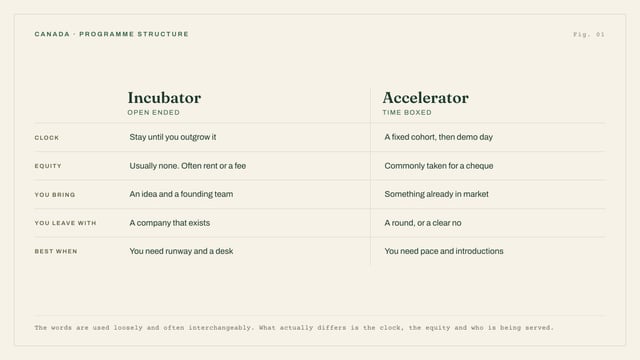
Is the trade proportional to the benefit? The DMZ Incubator takes 2.5%. Y Combinator takes 7% for its first $125,000. Those are permanent trades, and programs that take equity should clear a higher bar than free ones. If you are unsure which you need, our incubator vs accelerator guide breaks down the difference, our Delaware flip breakdown covers the structural side, and our pre-seed guide covers what that same equity could get you on the open market. If you have not incorporated yet, settle that before any program asks for your cap table: our guide to incorporating a Canadian startup in 2026 covers federal versus provincial, share structure and founder vesting.
The pattern founders describe most often is that the program itself mattered less than what they did with the network afterward. The ones who compounded the most stayed in genuine contact with cohort peers, mentors and investors for years. That is the actual return.
Common questions
What is the best startup accelerator in Canada in 2026? It depends on what you are building. Creative Destruction Lab is the strongest for science-based companies with real technical IP, and it takes no equity. DMZ at Toronto Metropolitan University is the largest incubator for software companies with early revenue. Next 36 is built for students and recent graduates, Velocity for Waterloo founders, and Foresight for cleantech. Pick the one that matches your sector and stage, not the most famous name.
Do Canadian accelerators take equity? Most of the well-known ones do not. Creative Destruction Lab, Velocity, District 3 and every Next Canada program take none, and Next 36 dropped its 2.5 percent requirement in September 2025. The DMZ Incubator is the notable exception at 2.5 percent common equity. Some programs charge a monthly fee instead, such as Foresight, whose programs start at $100 a month.
Which Canadian accelerators give you money? Fewer than founders expect. Creative Destruction Lab, Next 36 and NextAI put in no cash. Communitech's Fierce Founders Intensive Track offers $30,000 to $50,000 in milestone-based funding, New Ventures BC awards $110,000 in cash and prizes to its winner, and Velocity runs $5,000 and $25,000 pitch awards. For a cheque on standard terms, Y Combinator invests US$500,000 and funds Canadian corporations again in 2026.
Is Techstars Toronto accepting applications in 2026? No. The Toronto accelerator has not run a cohort since 2024. Techstars has been rebuilding it, but no managing director hire or cohort date has been announced, and Toronto is not on its list of open accelerators. FounderFuel in Montreal is also quiet: its last cohort was in 2023.
What are the next Canadian accelerator deadlines? Next 36 closes on October 14, 2026 for its 2027 cohort. NextAI opens on October 15 and closes on December 9, 2026. Y Combinator's Winter 2027 batch closes on November 2, 2026. The DMZ Incubator, Velocity, District 3 and Foresight take applications on a rolling basis. Creative Destruction Lab's 2026/27 applications closed on July 24, 2026.
Sit down with founders who have done it
The fastest way to learn how a program really went is to ask someone who did it: which Demo Days produced term sheets, which mentors stayed in touch, and whether the equity was worth it. That conversation happens at dinner, not in an application portal.
Founder Feast runs founder dinners in Vancouver, San Francisco and Los Angeles every other Thursday at 7pm: five hand-picked founders at a restaurant we choose, no pitching. Membership is $39.99 a month (CAD in Vancouver), you pay the restaurant for what you eat, and every member is vetted before they sit down. If you are weighing accelerator options for the next round of intakes, apply for your first dinner. Here is how a Vancouver dinner night runs.
Related reading
- Incubator vs accelerator: which one Canadian founders actually need
- Toronto startup accelerators and incubators: the 2026 list
- Y Combinator in Canada: open again, and when to flip to Delaware
- How Canadian founders raise pre-seed funding in 2026
- How to incorporate a Canadian startup in 2026: federal vs provincial
- Canadian deep tech startups worth watching in 2026
- BC startup ecosystem guide (2026)