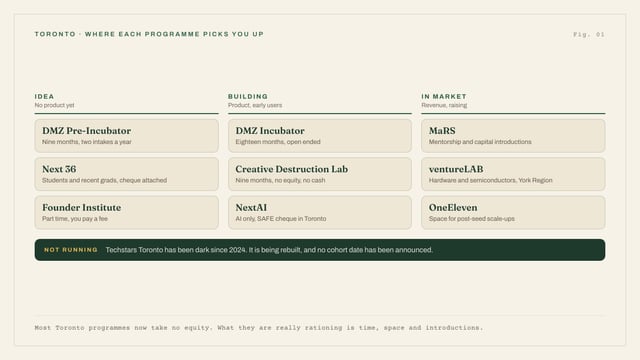
Toronto is the largest startup ecosystem in Canada by a wide margin. In 2024, Toronto-Waterloo founders raised an estimated $5.1 billion CAD, roughly 60% of all Canadian venture capital. The region houses MaRS, CDL, DMZ, Techstars Toronto, and a depth of operator talent that simply doesn't exist anywhere else north of the border.
But "big ecosystem" and "easy place to build" are not the same thing. This is the honest 2026 guide for founders thinking about starting a company in Toronto: where the money lives, who the buyers are, what the talent costs, and what most second-time founders wish they'd known before they filed their articles.
The Capital Picture: Concentrated, Mostly Series A+
If you are looking for pre-seed money in Toronto, you are looking in the right city, but you are not the only one. Toronto attracts hundreds of new applications every quarter to programs like CDL, NEXT, DMZ, and OneEleven. The angel scene around MaRS and the Creative Destruction Lab cohorts is real, but it is also crowded. A clean deck and a warm intro still matter more than a cold pitch.
Series A and beyond is where Toronto truly differentiates. Real Ventures, Inovia, Georgian, Information Venture Partners, Radical Ventures, BDC Capital, and the major US firms (Bessemer, USV, a16z, Sequoia) all run active books here. If you are building an enterprise SaaS company, an AI infrastructure company, or anything fintech, you can raise a $20M+ round from Toronto-based capital without ever leaving the city.
The catch: Toronto investors increasingly co-invest with American leads on anything Series B+. The Delaware-flip discussion that has dominated Vancouver and Montreal startup chats now happens just as often in the King West coffee shops. We covered the Delaware flip in full detail here.
Talent: Deep, Expensive, Mobile
Toronto's tech workforce is the largest in Canada and growing faster than any city in North America according to CBRE's 2024 Scoring Tech Talent report. The University of Toronto, Waterloo, Western, McMaster, and Queens all funnel new grads into the GTA every May. The Vector Institute has cemented Toronto as a global AI hub.
Costs have caught up to the talent depth. A senior software engineer in Toronto now commands $160K–$210K base, materially above Montreal or Vancouver but still 30–40% below the SF Bay Area equivalent. The practical implication: Toronto is a great place to hire engineers 2, 3, and 4. Bootstrapping a founding team from scratch here is expensive enough that many founders incorporate, raise their first $1M, and then start hiring.
The flipside is mobility. Toronto engineers leave for SF, NYC, and remote US salaries constantly. Retention requires either great equity, genuine mission, or a manager who can actually coach. Founders who treat their first 10 hires like SF founders treat their first 10 hires (with real comp bands, real reviews, real career conversations) keep their teams. Founders who don't, lose them within 18 months.
Incorporation: Federal vs. Ontario
Most Toronto founders incorporate federally under the Canada Business Corporations Act, not provincially under the Ontario Business Corporations Act. The federal route gives you name protection across Canada, easier inter-provincial expansion, and a cleaner story for US investors. It costs about $200 more in legal fees and $20/year more in maintenance. Worth it.
If you plan to flip to Delaware within 24 months, talk to a Canadian tax lawyer (not just a corporate lawyer) before you file anything. The section 85 rollover that preserves your tax basis on the flip has rules that are easier to comply with when you set up the original Canadian entity correctly.
The Networks That Actually Matter
Toronto has more startup events per week than any Canadian city. Most of them are noise. The networks that actually move careers and term sheets are smaller, quieter, and harder to get into.
- CDL alumni network: If you graduated from a Creative Destruction Lab cohort, you have access to a slack community that includes most of Toronto's serious technical founders.
- MaRS senior advisor pool: Less flashy than CDL but deeper on B2B SaaS and health tech.
- DMZ and OneEleven alumni: The early-stage Toronto founder mafia, especially for fintech and consumer.
- Founder dinners: Smaller curated tables (4–6 founders) consistently produce more value than 200-person mixers. This is what we built Founder Feast around. Our tables sit in Vancouver, San Francisco and Los Angeles, so a Toronto founder who travels can take a seat on either coast.
What Toronto Founders Should Actually Optimize For
Building in Toronto in 2026 is a strategic choice with real trade-offs. The advantages are concrete: depth of capital, depth of talent, proximity to US flights, an exit market that finally includes meaningful Canadian IPOs (Shopify, Lightspeed, Nuvei) alongside US M&A.
The trade-offs are equally concrete: higher cost than Montreal or Vancouver, more competition for every hire and every term sheet, and a network that rewards depth over breadth. The founders who do best here are the ones who pick a niche, go deep, find their five-to-ten true peers, and ignore the noise.
If you are thinking about whether Toronto is the right place to build, the answer almost always depends on what you're building. Enterprise SaaS, fintech, AI infrastructure: Toronto. Consumer hardware, deep ocean tech, gaming: probably not. The ecosystem rewards what it has already produced, and tries hard to ignore everything else.
That's not unique to Toronto. It's just true everywhere there are more applicants than seats.