People regularly ask why we don't scale up. "Why not 10 people? 20? You'd make more money." It's a fair question. And here's why we never will.
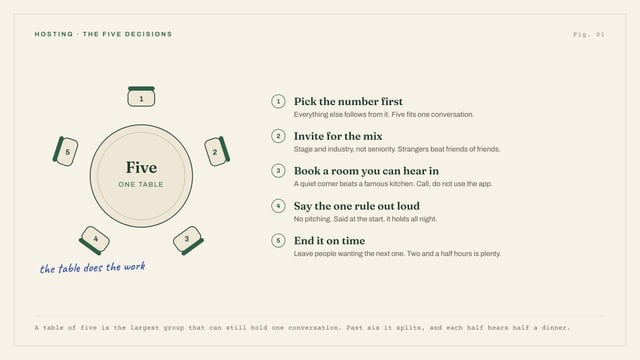
Five is not an arbitrary number. It's the result of hosting dinners, a lot of post-event reflection, and research that kept pointing us to the same conclusion: the magic of a great dinner disappears the moment you add too many people to the table.
The Dunbar number and dinner math
Robin Dunbar, the Oxford anthropologist famous for his research on human social cognition, found that meaningful conversation maxes out at around 4–6 people. Beyond that threshold, the table splits. Side conversations form. Someone starts dominating. Someone else goes quiet. The shared thread that makes a dinner feel like a dinner unravels into something closer to a cocktail party.
At 5 founders, everyone talks to everyone. You hear every story. Nobody gets lost. The conversation has a natural rhythm because every voice fits inside it. That's not a design choice we made. It's a biological reality about how humans process conversation in groups.
If you want to go deeper on the science of why small dinners outperform large events, we covered it in detail in Why Founder Dinners Work Better Than Networking Events.
Vulnerability needs safety
Founders carry things they can't say in public. A fundraise that quietly fell apart. A co-founder conflict that nearly ended the company. The creeping anxiety that everyone else has it figured out and you're the only one faking it.
Those conversations don't happen at a table of 15. They happen when the group is small enough that trust forms naturally, when you can read the room, when you know that what you share stays at the table.
Psychological safety, the kind that lets founders be honest about what's actually going on, is a function of group size. The bigger the group, the more people perform. The smaller the group, the more people connect. Five is the number where performance gives way to presence.
Curation works better at scale
With 5 seats, we can be surgical. We think about industry diversity, not 5 SaaS founders staring at each other across a table. We think about stage diversity, mixing early-stage founders with founders who've been through what they're about to face. We think about personality mix, making sure there are enough introverts to listen and enough extroverts to drive the conversation forward.
At 20 seats, curation becomes impossible. You can set general criteria, but you can't engineer a table dynamic. You can't guarantee that everyone will get meaningful airtime or that the perspectives in the room will spark something useful. You just have to hope the randomness works out. That can produce a fine evening. It rarely produces a transformative one.
The economics of attention
Here's a simple way to think about it. A dinner runs about two hours. With 5 people at the table, each person gets roughly 20–25 minutes of focused group attention. That's enough time to tell your actual story, to get real questions, to receive something useful in return.
At a table of 10, that drops to 10 minutes. At 20, you're looking at 5 minutes per person. At that point, you're not having a conversation. You're giving a lightning talk to strangers. The depth evaporates. What's left is surface.
Most networking formats optimize for reach. Meet more people. Maximize exposure. We optimize for depth. Have fewer conversations, but make each one count. The math is simple. The implications for how you design an event are everything.
What the number is for
Five is chosen for what should happen after the dinner, not just during it. A table small enough that everyone gets real airtime is a table where people know enough about each other to follow up: in the table's in-app chat the next morning, with an introduction, with a coffee. The goal is that you leave your first dinner feeling genuinely known by the people across the table.
That's not left to luck. It's the result of a format that prioritizes depth over volume at every decision point. Five founders per table isn't a constraint we're working around. It's the thing that makes the whole model work.
We've had opportunities to run larger events. Private buyouts of whole venues. Conference-style dinners for 50 people. We've said no to all of them. Not because we don't see the commercial logic, but because we know what gets lost the moment you cross the threshold.
We optimize for depth, not reach
Scaling a dinner network doesn't mean putting more people at each table. It means running more tables. Each one small. Each one curated. Each one designed to give five founders two hours of the kind of conversation that actually changes something.
If you're a founder in Vancouver, San Francisco or Los Angeles who wants fewer connections but better ones, you know where to find us. Apply for a seat. Dinners run every other Thursday at 7pm. The table is small on purpose.