Most founders have had the same night more than once. You go to a mixer, you shake forty hands, you collect a stack of LinkedIn requests, and a month later you can't remember who half of them were. Almost none of it turns into a real relationship.
That isn't bad luck. It's the format. And it explains why a lot of founders are trading four mixers a month for one dinner every other Thursday.
The room with 300 people in it is built for volume. The table with 5 people at it is built for memory. If you've ever walked out of a "founder mixer" at 9pm with a pocket full of contacts and zero new relationships, the problem isn't you. It's the room.
The group-size math nobody applies to networking
Robin Dunbar, the Oxford anthropologist, is best known for the idea that humans can only maintain a limited number of relationships. Less famous is his work on conversation itself: when people form conversation groups freely, those groups tend to top out at around four people. Add more and the group quietly splits into side chats.
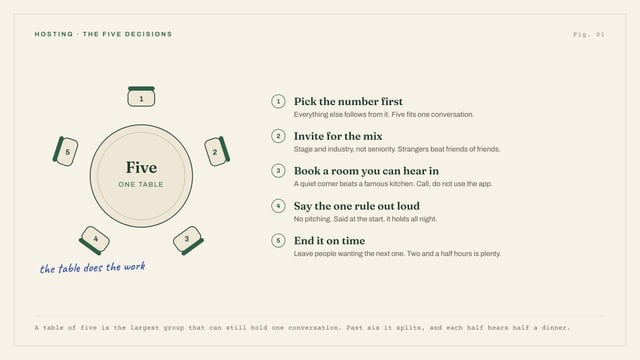
Five at a table sits right at that edge. Everyone can speak. Everyone can listen. Nobody disappears.
Compare that to a typical "founder night" with 150 attendees. You get a string of short, interrupted exchanges, each one restarting from "so what do you do?" At a table of five, one conversation can run for two hours and actually go somewhere.
This is why every Founder Feast table seats 5. Not 4, not 8. Five founders who can actually hear each other over a two-hour dinner. The format isn't a marketing choice. It's the group size that lets one conversation hold.
Eating together changes the conversation
Researchers at Cornell studied firefighters and found that crews who ate their meals together cooperated and performed better than crews who didn't. Sharing a meal is one of the oldest ways people build trust, and it still works.
You can't fake that at a stand-up reception with a glass of warm Sauvignon Blanc. It requires sitting down. It requires plates. It requires the two-hour arc of an actual meal.
There's a reason so many business relationships get built over food. Investors take founders to dinner before they commit. Y Combinator built its program around shared dinners. The format works because people relax at a table in a way they never do standing up.
If you want the deeper take on this, our piece on how to network as a founder breaks down what to actually do at the table once you're there.
Curation kills the lottery
Open networking is a lottery. You might sit next to the perfect lead investor. You might also spend 40 minutes cornered by someone selling SEO services to dentists. The randomness is the product, and the randomness is the problem.
Curated dinners flip the equation. At Founder Feast, a person reads every application before anyone is seated. We match on stage (pre-seed founders don't get stuck at a Series B table), industry diversity (we deliberately mix verticals), and personality (we balance talkers with listeners).
The point of mixing verticals: a SaaS founder can end up across from a fintech founder and a consumer brand founder. They would never have met at a vertical-specific event, and each of them sees the others' problems from an angle they can't get inside their own industry.
We compare the formats side by side in Founder Feast vs networking events and answer the cost question directly in is Founder Feast worth it.
The follow-through gap
Here's the part most networking organizers don't want to talk about: at a big event, the relationships don't fade afterwards. They never form. Twenty ninety-second conversations don't give anyone enough to follow up on.
Dinners are designed for a different curve. After two hours over a meal, you know what the other four are working on, what they're stuck on, and who in your network could help. The follow-up writes itself: a coffee, an introduction, a question sent the next week. And because the table keeps talking in its in-app chat afterwards, nobody has to chase a business card to keep the thread going.
That's the compounding piece. A connection made at a table can spread, because the people at it know enough about each other to make a real introduction. Read more on the kinds of connections the format is built for in Founder Feast connections.
The economics favor dinners
A mixer ticket usually costs something, takes three hours, and leaves you with a handful of superficial conversations. Cost per meaningful connection: hard to calculate, because there usually aren't any.
A Founder Feast membership is $39.99 CAD a month in Vancouver ($39.99 USD in San Francisco and Los Angeles) and covers your seat at every dinner you book. You pay the restaurant for what you eat. You get a curated table, two hours of real conversation, and a table chat that carries on after the night ends. Go to every dinner and the cost per conversation is small next to a single conference ticket.
It's not even the same product. One is entertainment. The other is infrastructure for your company. Founders raising pre-seed rounds across Canada in 2026 lean heavily on warm intros, and warm intros come from people who actually know you.
Common questions
How is this different from a private mastermind? Masterminds are recurring and topic-locked. A Founder Feast dinner has no curriculum, just conversation, and you meet new people at each table instead of the same five forever.
What if the table is awkward? With 5 people, it's rare but it happens. That's why a person reads every application and balances each table by stage, industry and personality, and why the format keeps the table small enough that everyone gets drawn in.
Can I pitch at the table? No. The no-pitching rule is sacred. The whole point is dropping the founder armor for two hours. You can absolutely follow up after to talk shop. At dinner, you're a person.
Is there a Toronto scene worth showing up for? Yes, and it's stronger than people from the West Coast expect. Our building a startup in Toronto piece covers the current density of operators and capital, and our Toronto founder restaurants guide covers good rooms for a founder meal. Founder Feast dinners currently run in Vancouver, San Francisco and Los Angeles.
Where to go from here
If you've been hitting the mixer circuit and your contact list is growing but your business isn't, the format is the problem, not the city. Every city has plenty of capable founders. They're just spread across rooms that don't let them talk.
Five founders. One restaurant. Every other Thursday at 7pm in Vancouver, San Francisco and Los Angeles. No pitching. Every Founder Feast dinner is the same shape because the shape is what works. Apply for a seat and we'll match you to a table where the conversation actually goes somewhere.