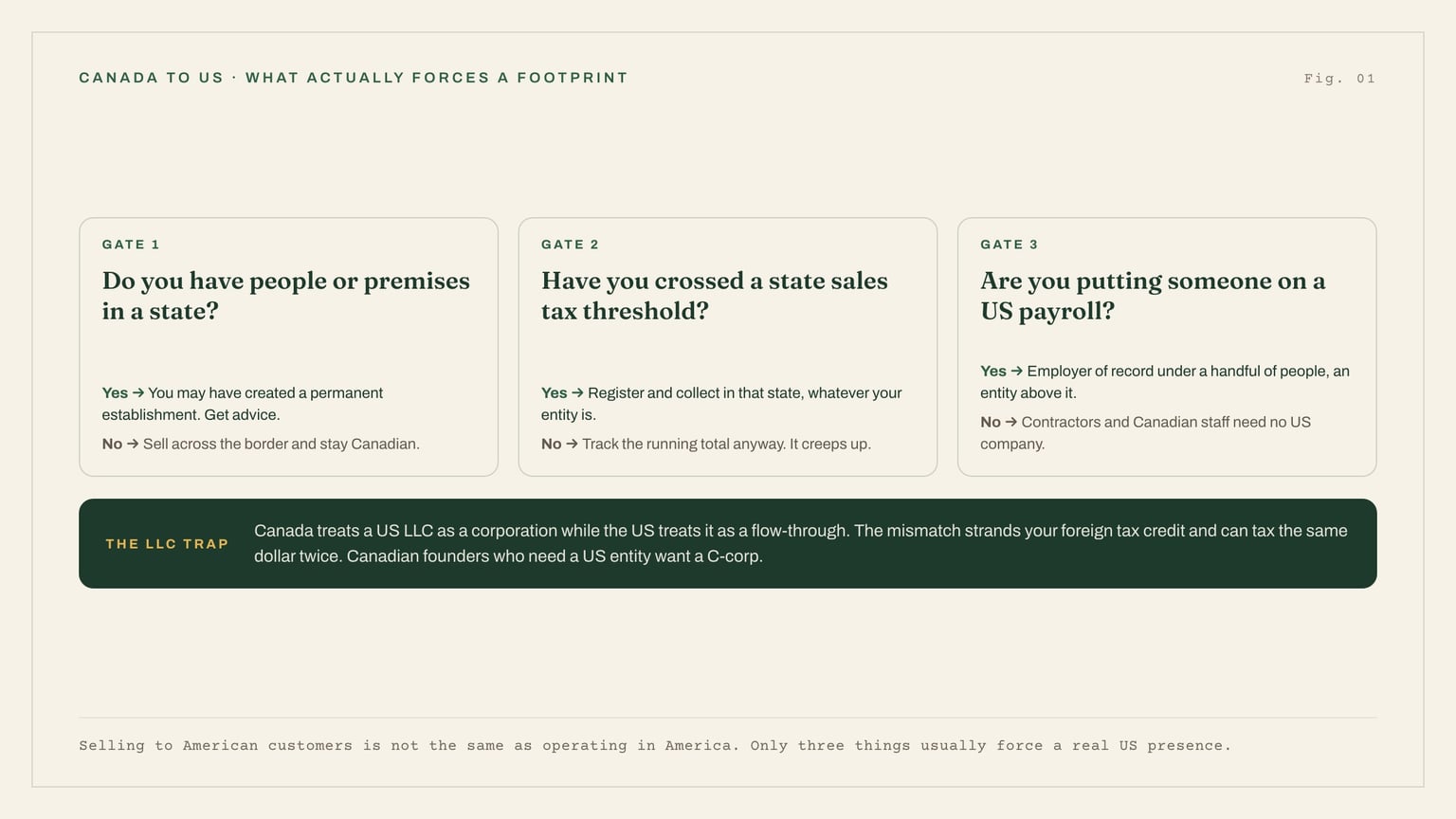
The most expensive mistake Canadian founders make going into the US is not a bad hire or a mispriced deal. It is setting up an LLC because a American lawyer mentioned one on a call, and finding out two years later what that costs.
The United States treats an LLC as a flow-through, taxing the members directly. Canada does not. The Canada Revenue Agency treats a US LLC as a corporation, which means the income the US attributes to you personally is income Canada does not see the same way. The result is a foreign tax credit mismatch that can leave the same dollar taxed on both sides of the border, with no clean way to unwind it after the fact.
If you need a US entity, you almost certainly want a C-corp. That is the single most valuable sentence in this article, and it is worth an hour with a cross-border accountant before you act on anything else here.
With that out of the way, here is what actually forces a US footprint, in the order you will hit it.
Selling to Americans does not require a US company
Start from the position that you need nothing, and make each obligation prove itself.
A Canadian corporation can invoice American customers, hold US dollars, take Stripe payments and deliver software across the border. Your customers being American does not create a US tax presence. This surprises founders who have been told to "set up in Delaware" as a first step, which is advice aimed at raising from American investors rather than at selling to Americans. Those are different problems with different answers, and our Delaware flip guide covers the fundraising one.
What creates an obligation is presence. Under the Canada-US tax treaty, a permanent establishment is generally triggered by a fixed place of business in the US, or by a dependent agent there with the authority to conclude contracts on your behalf. Delivering a service remotely from Canada, on its own, generally is not that.
So the honest first answer for most seed-stage Canadian companies is: sell across the border, stay Canadian, revisit in a year.
Sales tax is the one that sneaks up on you
Nexus for sales tax works on completely different rules from income tax, and it does not care what entity you are.
Since the economic nexus regime took hold, states set a revenue threshold, commonly around one hundred thousand US dollars of sales into that state, above which you must register, collect and remit. The threshold varies. So does whether the state taxes software at all, and the list of states taxing SaaS has been growing, not shrinking.
Three things to internalise:
The obligation attaches to sales into a state, not to your location. A Vancouver company with no US anything can owe sales tax in six states.
It is retroactive to when you crossed, not to when you noticed. Uncollected tax comes out of your margin, because you cannot realistically go back and bill last year's customers for it.
It compounds silently. This is the one that turns into a real number during diligence, and it is a routine reason a term sheet gets repriced.
Track revenue per state from your first American invoice. It costs nothing while you are small and it is expensive to reconstruct later.
Hiring your first American
The moment you put someone on a US payroll, you need a way to pay them legally in their state. There are two routes and the choice is mostly arithmetic.
An employer of record hires the person on your behalf. They hold the employment relationship, handle state registration, payroll tax and benefits, and bill you a monthly fee per employee on top of salary. You get someone working in three weeks with no entity, no EIN and no state filings.
Your own US subsidiary means an EIN, registration in each state you employ in, a payroll provider, benefits, and a US tax return every year. Slower and more administratively expensive up front, and materially cheaper per head once you have a handful of people.
The crossover is usually somewhere around five to ten employees, depending on how many states they are spread across. Below that, an EOR is almost always the right call. Above it, you are paying a premium for something you now have the volume to run yourself.
One thing worth knowing: a US employee with authority to close deals can be exactly the dependent agent that creates a permanent establishment. The hire that feels like a sales decision is often the one that changes your tax position, so sequence the advice before the offer letter, not after.
Contractors are a different question with its own trap, because US worker classification rules are stricter than most Canadian founders assume, and getting it wrong is a state-level problem.
Getting yourself across the border
This is where founders get the most bad advice, usually from people who have only ever hired employees rather than moved themselves.
B-1 business visitor status lets a Canadian enter for meetings, conferences, negotiations and site visits. It does not let you work. Sitting in your own US office doing your job is not a business visit, and the line matters at the border.
TN status under the trade agreement is genuinely useful, and it is not for you. It requires a US employer, and the schedule of eligible professions has no founder or entrepreneur category. Engineers, scientists and management consultants on your team may qualify. You running your own company generally will not.
L-1 intracompany transfer requires that you have been employed by the Canadian entity for at least twelve months before the transfer. That is a real constraint founders discover too late, and it is a reason to put yourself on payroll properly and early if a move is anywhere on the horizon.
E-2 treaty investor status is usually the cleanest founder route. Canada is a treaty country, it is built around someone who has invested substantial capital in a US business and is coming to direct it, and it does not need a separate employer to sponsor you. It is not permanent residence and it ties you to the business, but for a founder relocating to run a US operation it fits the actual facts.
O-1 exists for extraordinary ability and is real if you have the record for it, though it still needs an entity willing to sponsor, which is awkward when the entity is yours.
Immigration is fact-specific and changes. Treat this as a map of the options, then get an immigration lawyer to read your actual situation.
Banking, and getting paid
The American fintech stack that everyone recommends, Mercury and Brex among them, generally requires a US entity with an EIN. They are not routes around incorporating, they are things you get after.
Without a US entity, a Canadian company can still take US dollar payments through Stripe and hold USD in a Canadian account. The cost that quietly eats your US margin is foreign exchange. Traditional bank spreads on CAD to USD conversion run several times what the specialist services charge, and at a few hundred thousand dollars of US revenue that difference is a real line item. Look at it once, properly, rather than accepting whatever your business bank does by default.
If you do incorporate, an individual Canadian director may need an ITIN, which takes a couple of months, so start it before you need it.
What the government will pay for
Canada funds export expansion more generously than most founders realise, and the programmes are chronically under-applied for.
CanExport SMEs reimburses a share of the costs of entering a new market, up to a meaningful per-market cap, covering things like market research, trade shows, legal advice on foreign regulation and adapting marketing. It runs in intakes that open and close, so the practical move is to check current status before planning spend around it.
The Trade Commissioner Service is free, staffed in US cities, and will make introductions. It is the least glamorous and highest return item on this list.
EDC and BDC both run programmes relevant to companies scaling into the US, weighted toward those moving physical goods.
On goods: the trade environment between Canada and the US has been volatile through 2025 and 2026, with tariff measures affecting a substantial share of Canadian exports. If you ship anything physical, the tariff position is now a core part of your US pricing model rather than a footnote, and it is worth re-checking rather than trusting anything written months ago. If you sell software, the tariff measures have not touched you directly, though your customers' budgets may feel them.
Common questions
Should I incorporate in Delaware before selling to the US? Not for selling. Delaware is about raising from American investors. Deciding the two questions together is how founders end up with an entity they did not need and a tax return they now file forever.
Can I just use my Canadian entity and ignore all this? Until you have people, premises or payroll in the US, largely yes on income tax. Sales tax is the exception and it applies to you regardless.
How much US revenue before this gets serious? The sales tax question starts at your first American customer and bites around a hundred thousand dollars into any single state. The entity question usually waits until you are hiring there.
Do I need a US address? For an entity, yes, and a registered agent supplies one. It does not create a permanent establishment on its own.
The part no advisor covers
Every question above has a professional who answers it for money, and you should pay them. What none of them can tell you is whether the US move is working, because they only see their slice.
The people who can are the founders one or two years ahead of you who made the same move. What the first American hire actually cost. Which state surprised them. Whether the EOR was worth it or whether they should have incorporated sooner. That information exists almost entirely in conversation, and it does not get written down.
Founder Feast seats five founders at one table, matched on stage and industry, in Vancouver, San Francisco and Los Angeles. No pitching, which is the one rule. For a Canadian founder working out a US move, a table with someone who already did it is worth more than another advisory call. Membership is $39.99 CAD a month and covers every dinner you book.
This article is general information, not tax, legal or immigration advice. Cross-border rules change and yours are specific to you. Get a cross-border accountant and an immigration lawyer before you act.
Related reading
- Canada vs US startups, where to base the company in the first place.
- Canadian founders and US investors.
- The C-corp question for Canadian founders.