Most first hires at Canadian startups are made in a panic. A contract lands, a bug ships, an investor asks about the team slide, and suddenly you're offering equity to a friend of a friend at 11pm on a Tuesday.
There's a better way, and it's not complicated. It's just sequenced. The first 10 hires at a startup in Canada follow a rough pattern that repeats across Shopify, Clio, Jobber, 1Password, Hootsuite, and about a hundred smaller companies you haven't heard of yet. The trick is knowing the pattern before you need it.
This is the tactical version. Roles, CAD comp, equity, and where to actually find these people in Toronto, Vancouver, Montreal, and remote.
Engineer-first vs sales-first: pick based on your buyer, not your bias
The oldest debate in startup hiring. Here's the honest answer: it depends entirely on who you're selling to and whether the product exists yet.
If you're building a technical product for SMB or prosumer buyers (think Jobber, Later, Ada in their early days), engineer-first is almost always right. Your first four hires are engineers because the product needs to work before anyone will pay for it. Sales comes at hire 6 or 7, once you have something worth demoing.
If you're building enterprise software with a $30K+ ACV, you flip it. Your second or third hire is a founding AE, because the sales cycle is 4-9 months and you need someone dialing while engineering builds. Vidyard, Klue, and Coconut Software all hired sales early because they had to.
If you're pre-product-market-fit and still doing customer discovery, don't hire either. Hire a second founder or a founding engineer who can also talk to customers. Our guide on how to find a cofounder in Canada walks through that specifically.
The first hires startup Canada founders regret most are the ones made to fill a gap in the founder's confidence, not the company's roadmap.
Hires 1-3: the technical core
Assuming you're a solo or two-person founding team and you've raised a pre-seed or bootstrapped to first revenue, your first three hires are almost always engineering.
Hire 1: Founding Engineer (full-stack). This person ships features solo, owns infrastructure, and doesn't need a PM. CAD comp in 2026: $130K-$170K base in Toronto or Vancouver, $110K-$150K in Montreal or remote-Canada. Equity: 0.5%-2.0%, four-year vest, one-year cliff. If they're truly the first non-founder and taking real risk, push toward the top of that band.
Hire 2: Second Engineer (backend or frontend specialist). Fills the gap the founding engineer can't. CAD comp: $120K-$155K. Equity: 0.25%-0.75%.
Hire 3: Depends on the product. If you're B2B SaaS with a self-serve motion, this is a designer-engineer hybrid or a product designer. If you're infra or ML-heavy, it's a second backend engineer. CAD comp: $110K-$160K. Equity: 0.2%-0.5%.
Where to find them: internal referrals still win. After that, engineering-heavy Slacks like Tech Masters Canada, the Ladies Learning Code alumni network, and Bridgetown for senior ICs. If you're in Toronto specifically, we broke down hiring engineers in Toronto in more detail.
Hires 4-6: the first commercial hires
Once the product is real enough to demo and you have three or four paying customers, the shape of the company changes. You need someone whose job isn't building.
Hire 4: Founding AE or Head of Growth. For enterprise, hire a founding account executive. Someone who has closed at a Series A before, not a VP from a Series C. CAD comp: $110K-$140K base, $200K-$280K OTE. Equity: 0.4%-1.0%. For SMB or prosumer, hire a growth generalist instead: $95K-$130K base, 0.25%-0.5% equity.
Hire 5: Customer Success or Support Lead. Every customer you close in year one will churn if nobody owns them. This hire pays for itself in 6 months. CAD comp: $75K-$105K. Equity: 0.1%-0.3%.
Hire 6: Second Engineer or First Product Manager. By now the founding engineer is drowning. If you're technical, hire a PM. If you're not, hire another engineer and keep owning product yourself. CAD comp: PM $130K-$170K, engineer $125K-$160K.
A note on comp benchmarking: Canadian salaries are roughly 65-75% of US equivalents in equivalent roles, but the gap narrows for senior ICs and closes almost entirely for remote-first companies competing with US buyers. If you're raising from US investors, they'll expect you to pay closer to US bands. Our post on Canadian founders and US investors covers what changes.
Hires 7-10: filling the org chart, not just the gaps
This is where founders get sloppy. The first six hires are usually deliberate. Hires seven through ten often happen in a two-month blur after a Series A.
Hire 7: Second AE or Marketing Lead. If sales is working, double it. If not, hire a marketer who can build demand so your one AE isn't cold-calling forever. CAD comp: AE $110K-$140K base; marketing lead $100K-$140K. Equity: 0.15%-0.4%.
Hire 8: Senior Engineer or Engineering Lead. Someone who can start managing the three engineers you already have without needing full EM training wheels. CAD comp: $155K-$200K. Equity: 0.2%-0.5%.
Hire 9: Ops or Finance Lead. Contracts, payroll, US subsidiary paperwork, procurement. If you did a Delaware flip, this person keeps you from getting sued by the CRA and the IRS in the same quarter. CAD comp: $95K-$135K. Equity: 0.1%-0.25%.
Hire 10: Second Designer, Data Hire, or Second CS. Whichever function is now the bottleneck. By this point you should know from the metrics, not the vibes. CAD comp: $105K-$150K depending on role. Equity: 0.1%-0.3%.
Equity math check: your first 10 hires should total roughly 4-8% of the cap table. If you're above 10%, you were too generous. If you're below 3%, you underpaid people who took real risk and you'll pay for it in retention.
Where to actually source in each city
Toronto: MaRS, DMZ, and Creative Destruction Lab alumni networks. Elevate and Collision hangovers. The Slack for Toronto product managers. Waterloo new-grad pipelines still produce disproportionately strong engineers, but the competition with Shopify, Cohere, and Ada is brutal. Read our take on building a startup in Toronto for more on the local hiring market.
Vancouver: UBC and SFU new grads (BCS program at UBC punches above its weight). Ex-Hootsuite, ex-Later, ex-Article talent is currently in circulation and worth chasing. Slack communities like Vancouver Tech Journal's founder list. Physical presence matters here more than in Toronto, and coworking spaces like the ones we listed for Vancouver founders are where you'll actually bump into candidates.
Montreal: Element AI diaspora, Coveo, Lightspeed, and the whole McGill/Polytechnique/UdeM pipeline. ML talent is cheaper here than anywhere else in Canada and is genuinely world-class. French language is not required for engineering roles but helps for local sales hires.
Remote-Canada: Kelowna, Ottawa, Halifax, and Calgary are producing serious talent and comp is 10-20% below Toronto/Vancouver for the same seniority. If you're open to remote-Canada, your candidate pool triples. See the Kelowna startup ecosystem for one example.
Timing: what usually goes wrong
Most first hires startup Canada founders make happen either three months too late or six months too early. The pattern I see most often:
Too late: The founder is drowning for a full quarter before posting the role. By the time the hire starts, the founder is burned out and doesn't have the energy to onboard them properly. Hire quits in 8 months.
Too early: The founder raises a seed round, feels the pressure to spend it, hires four people in six weeks, and burns 40% of the runway on salaries before finding product-market fit. This is the more common failure mode in 2026 because seed rounds got bigger and the pressure to deploy is intense.
Rule of thumb: hire when the pain of not hiring exceeds the pain of managing a new person for the next six months. If you're not sure, wait two more weeks. The signal will get louder.
Common questions
Should I hire contractors first or go straight to full-time? Contractors for anything under 20 hours a week or clearly bounded (design system, one integration, a rebrand). Full-time for anything on the product roadmap. Contractors won't own outcomes the way you need them to at this stage.
Do I need to offer RRSP matching or benefits from hire one? Health and dental yes, from day one. It's table stakes and costs $150-$300 per employee per month through providers like League or Honeybee. RRSP matching can wait until hire 10 or after a Series A.
How do I compete with Shopify or Google on comp? You don't, on base. You compete on equity, ownership, and the actual work. Be honest that base is 20-30% below FAANG and make the equity meaningful. If your equity story isn't compelling, fix the equity, don't inflate the base.
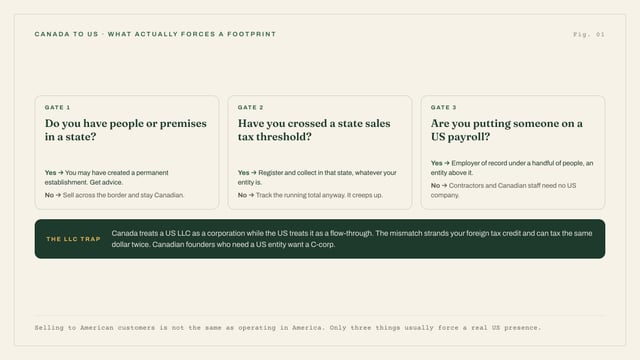
Should my first 10 hires all be in Canada? Not necessarily, but there are tax and legal reasons to lean Canadian early, especially if you want SR&ED credits. Your startup lawyer should walk you through it before you make an offer to a US-based candidate.
Hire slower, talk to more founders
The best hiring advice I've gotten came from other founders who had just made the mistake I was about to make. Not from books, not from Twitter, not from recruiters. From someone two years ahead who could describe the exact conversation they wished they'd had.
That's why Founder Feast runs small dinners for 5 founders in Vancouver, San Francisco and Los Angeles. No pitching, no panels, just five founders who've probably hired the exact person you're about to hire. If that sounds useful, apply here.