Timeleft is the app that books you a restaurant table with a small group of strangers. You answer a quiz, pay a subscription, pick a date, and find out the rest later. By the company's own count it runs in more than 200 cities across 50-plus countries, and the US App Store gave it an Editors' Choice badge.
This is the general review: how it works, what it really costs, what reviewers keep saying, and who it suits. The city versions are separate: Vancouver, San Francisco and Los Angeles.
We run a founder dinner club in the same three cities, so we are not neutral. Every fact below comes from Timeleft's own pages, its App Store listing or Trustpilot, checked in October 2026, and we say where our view comes in.
How Timeleft works
The sign-up is a questionnaire, not a profile. Timeleft's own guide describes it as a short assessment of your personality and social energy, plus practical preferences: neighbourhood, language, dietary needs and budget. You fill it in once.
Then you book. Dinner is the main product; the app also lists drinks, coffees and group runs in many cities, and women-only dinners on Tuesdays in more than fifty. You can book up to 13 hours before an event starts.
Timeleft builds a table of four to six people it expects to get along, weighing personality, age range and language, and reserves the restaurant. You do not see names or photos in advance; the booking guide says you may see light details such as the industries people work in.
The restaurant is revealed late on purpose. Timeleft's guide says the day before; the App Store listing says on the day. Either way, you commit to a night you cannot research. The app offers icebreakers at the table, and afterwards a Connect feature lets you send a request to anyone you want to see again.
What it costs: the subscription plus the dinner
There are two bills, and only the first one is on the pricing screen.
The subscription. Timeleft's guide puts it at $19.99 a month in the United States and says pricing varies by market, so treat any number in a blog post, including this one, as roughly right and check the app for your country. The US App Store listing shows three tiers at $19.99, $46.99 and $62.99, the larger two being longer plans. There is no per-event ticket on top: an active subscription covers the events you book.
The meal. Not included. You order and pay the restaurant directly, which is why the quiz asks for a budget. A recurring complaint is landing at a restaurant above the budget you picked.
Cancelling. You can cancel the subscription at any time, effective at the end of the billing period. Missing a dinner you booked without cancelling costs a no-show penalty of 35 percent of the monthly subscription price.
So the honest monthly number is the subscription plus one restaurant bill for every dinner you attend.
What people like
The US App Store listing sits at 4.6 stars from about 8,700 ratings. The reviews that carry the score describe the same thing: a low-pressure way to meet people, because everyone at the table opted in to meeting people. Several are from people who had just moved to a city.
On Trustpilot, where the overall score is lower, 47 percent of 767 reviews are still five stars. Those praise the concept, the conversations and friendships that outlasted the night. Journalists who tried it, for Axios in Denver and Washington and for Time Out in Austin, wrote roughly the same arc: nervous walking in, a slow start, then an evening they would not otherwise have had.
What people complain about
Trustpilot is where the complaints collect: a 3.2 TrustScore, with 27 percent of reviews at one star. The themes repeat enough to be useful.
Billing is the biggest: renewals people did not expect, charges continuing after they thought they had cancelled, no refund when an event fell through. Support is second, with reviewers describing waits of five to seven days for a reply.
The room is next: restaurants too loud to hold one conversation, reservations the venue did not have, last-minute venue changes. For a product whose whole output is conversation, noise is the failure that matters most.
Matching is fourth: tables that felt random on age, uneven gender balance, no way to see the group before committing. App Store reviews add a restaurant outside the price range chosen in the quiz, and friction when a shared bill lands. Last, nights that do not happen: events cancelled for low bookings, or tables where someone did not show.
None of this means a typical night goes badly. The split in the ratings says most do, and the ones that do not generate detailed reviews.
Who it is for, and who it is not for
Timeleft published its own self-assessment, and it is candid. The product is built for adults who find unstructured social events exhausting, who prefer small groups, and who find it easier to say yes when there is a clear end time. If that is you, the format removes every decision except showing up.
It also says who should skip it: people primarily looking for dates, because the matching ignores romantic compatibility; people who need to know who they are meeting before they agree to show up, because the late reveal raises anxiety rather than lowering it; and people who prefer spontaneous plans, because the format runs on fixed commitments.
From our side, add anyone new to a city, anyone working remotely, and anyone who wants a standing reason to leave the house. One rule from the reviewers who liked it: go three or four times before you decide. A single table tells you nothing.
Timeleft for founders
Timeleft is clear in its own words: not a dating app, not a dinner club, and not a networking tool. Its matching uses personality, age range and language. It never asks what you are building or what stage you are at, because that is not what it is for.
So if you are a founder looking for people who understand your week, the mismatch is structural. Across four to six people drawn from a whole city, the chance that someone else is building something is low, and the chance they are at your stage is lower. You will likely have a good dinner, and the table did not come out to talk about work.
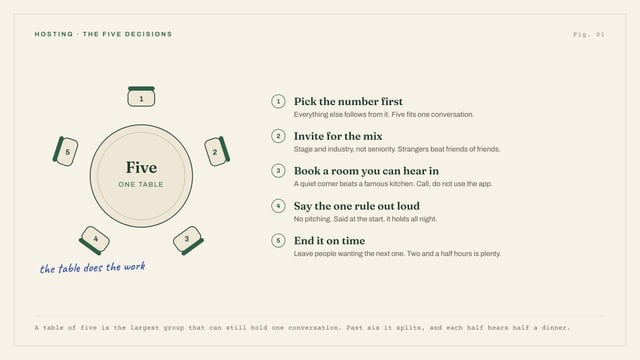
That is the job Founder Feast exists for: an invite-only founder dinner club in Vancouver, San Francisco and Los Angeles. You apply once and a person reads it, usually within a day, with no interview call. Dinners are on Thursday evenings at 7pm, five vetted founders per table, sometimes with an investor or operator, matched on stage and industry. The restaurant and who is coming are revealed 24 hours before. You book a Thursday in the app, pay the restaurant for your own food, and can cancel anytime. Membership is $39.99 a month, CAD in Vancouver and USD in San Francisco and Los Angeles. No panels, no name badges, no pitching.
Plenty of people use both: Timeleft for the city, a founder table for the company. The full comparison is in our Timeleft alternative guide for founders.
Common questions
How does Timeleft work? Answer a short questionnaire, subscribe, book a date. Timeleft groups four to six people and books the restaurant. No names or photos beforehand; the venue arrives the day before or on the day.
How much does Timeleft cost? Roughly $19.99 USD a month in the United States, varying by market, with longer plans on the US App Store at $46.99 and $62.99. The meal is paid to the restaurant on top.
Is Timeleft worth it? Yes if you want new people in your city and can enjoy a night you cannot plan. Ratings are split: 4.6 on the US App Store, 3.2 on Trustpilot. Go several times before judging.
Can you cancel Timeleft? Yes, any time, effective at the end of the billing period. Do it in the app before the renewal date. Skipping a booked dinner without cancelling carries a 35 percent no-show penalty.
Is Timeleft good for networking or meeting founders? No, by its own description. It matches on personality, not profession or stage. A vetted founder dinner is the direct route.
Related reading
- Timeleft vs Founder Feast, the head-to-head for founders.
- Timeleft in Vancouver, the city version with Canadian pricing.
- What an entrepreneur dinner club costs in 2026, if you are comparing membership models.