Most founder dinners are just networking events with chairs. Twelve people at a long table, three conversations running in parallel, and everyone leaves having talked to the two people either side of them about nothing in particular.
The good ones look almost identical from the outside and are built on about five decisions that get made before anyone shows up. None of them are about the food.
I have sat at a lot of both. Here is what actually separates a dinner people ask you to run again from one they politely never mention.
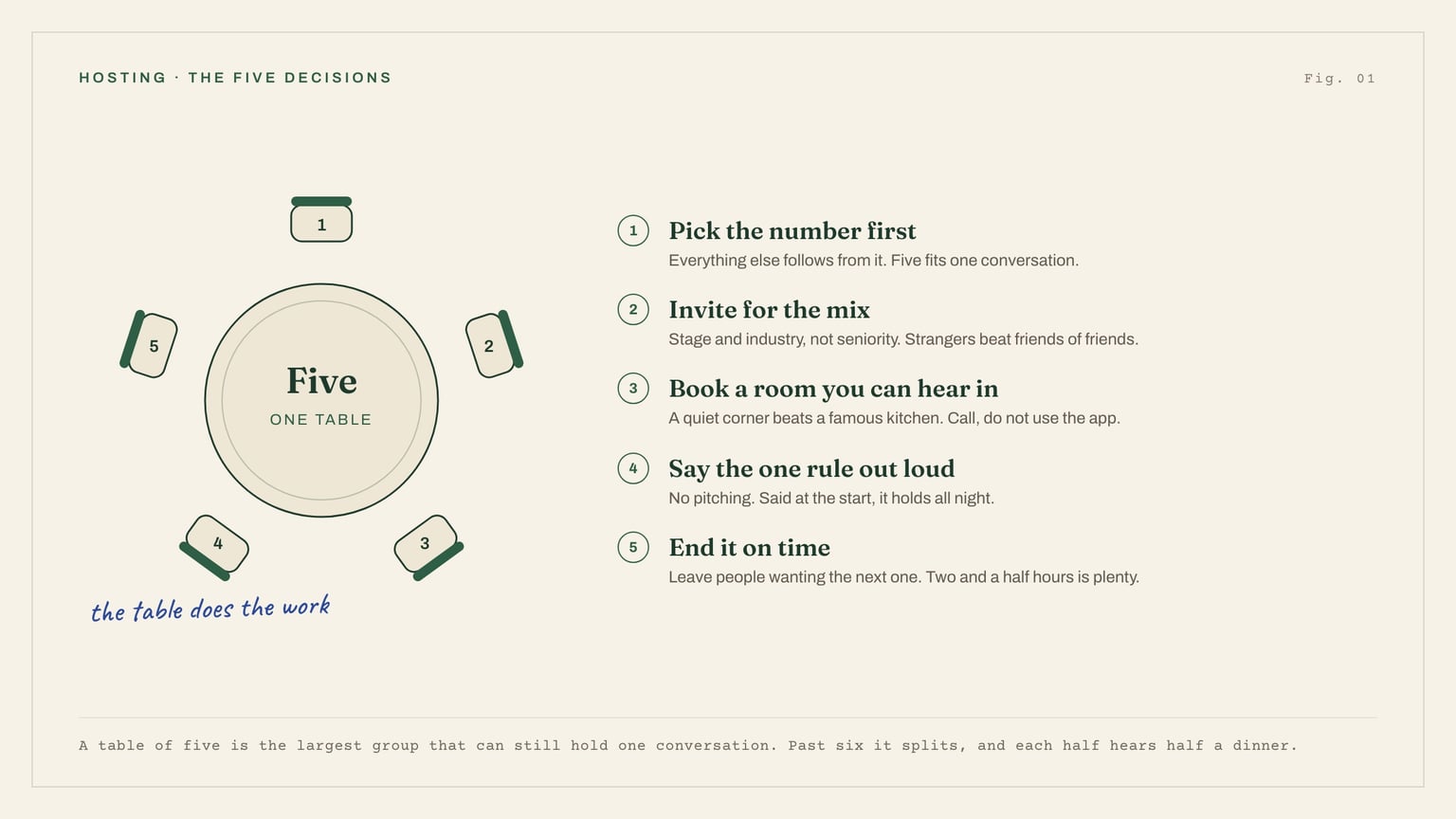
Pick the number first, and make it five
Everything else follows from this and almost nobody decides it deliberately.
Five is the largest group that can still hold one conversation. At six it begins to fracture under any noise. At eight it always splits into two tables that happen to share furniture, and the split is not clean, so people keep half-turning between conversations and following neither.
That matters because a founder dinner has exactly one product: the thing somebody says that they would not have said in public. That only happens in a single conversation where everyone is accountable to everyone. Split the table and you get small talk on both halves.
The pressure to go bigger is constant. Someone asks to bring a co-founder, someone forwards it to a friend, and eight feels more successful than five. It is not. If more people want in, run it twice. A second dinner costs you one more evening. A ruined dinner costs you the group.
Hold the number. It is the whole thing.
Invite for the mix, not the résumé
The instinct is to invite up. Get the most impressive founder who will say yes, then build around them.
That produces a bad dinner. A table with one person clearly senior to everyone else turns into an audience, and the four others spend the night asking questions instead of talking. You wanted a conversation and you booked a fireside chat.
What works is same stage, different industries, and mostly strangers.
Same stage means the problems rhyme. Two people at seed talking about a first sales hire is a real conversation. A Series B founder telling a pre-revenue founder about a first sales hire is a lecture, however kindly it is delivered.
Different industries means nobody is guarding anything. Put two founders from the same market at one table and both spend the evening being careful, which everyone can feel.
Mostly strangers is the one people resist. It feels safer to invite friends. But a table of people who already know each other defaults to catching up, and you will get forty minutes of gossip before anyone says anything about the work. One or two people who already know each other is fine and helps the room warm up. Five friends is a night out, which is lovely and is not this.
Book a room you can hear in
This is where more dinners die than any other single cause, and it is entirely preventable.
The failure mode is picking on food. You choose the restaurant everyone is talking about, and it is talked about because it is busy, and busy means loud, and at seventy-five decibels a table of five is functionally three separate conversations. The food is excellent and nobody remembers anything anybody said.
Choose the room, not the kitchen. What you want is a corner, a back room, an early sitting, or a place with soft surfaces and space between tables. A very good neighbourhood restaurant on a Tuesday beats the city's best on a Friday, every time.
And call them. Do not book through the app. A two-minute phone call gets you "we have a quiet table at the back" in a way no booking widget ever will, and restaurants are noticeably more accommodating to a person who rings and says they are bringing five people who will order properly and be gone by nine thirty.
Ask directly: which table in the room is quietest, and can you hold it.
Say the one rule out loud
No pitching. Say it in the first two minutes, before the menus are collected.
It feels awkward to announce a rule to adults. Do it anyway, because founders arrive braced. Everyone at that table has been to an event where a stranger opened with a deck, and until someone says otherwise, they are all half-expecting it. Naming the rule takes ten seconds and visibly changes the posture of the table.
What it buys you is the honest register. With pitching off the table, people describe what is actually hard rather than the version they say on stage. Churn that will not come down. A co-founder conversation they are avoiding. A month that was flat. Those are the things everybody needs and nobody volunteers first.
It also protects the quiet person. Without a rule, a table drifts toward whoever is most comfortable talking about themselves, and the founder who came in unsure whether they belonged says nothing all night and does not come back.
One rule. Said early. It holds all night.
End it on time
Say when it ends when you invite people, and then end it.
Two and a half hours is plenty. Somewhere past that, the table thins, the energy drops, and the last forty-five minutes overwrite the good two hours in everyone's memory. People leave remembering the tired end rather than the part that worked.
Ending on time also solves the most common reason busy founders decline. An open-ended invitation reads as an unknown commitment, and someone with a young kid or an early flight will just say no. "Seven to nine thirty" gets a yes from people "dinner sometime" never reaches.
If the table wants to keep going, let them move to a bar. That is a different event they chose, and it is the best possible sign the dinner worked.
The follow-up decides whether there is a second one
The dinner is not the product. The relationships afterwards are, and they need about ten minutes of your effort.
The next morning, send one message to all five with everyone's names and what they are building, one line each. That is it. It turns five people who met once into a group that can find each other, and it costs you the length of a coffee.
Do not build a Slack. Nobody needs another dead channel. If the group wants to keep talking they will, and the thing that makes that possible is simply having each other's names spelled correctly.
Then book the next one before enthusiasm decays. A dinner that happens once is a nice evening. A dinner that happens monthly is, after a year, one of the more valuable things in your professional life, and the only difference between the two is somebody sending a date.
What it costs
Less than people assume, and the cost is not really money.
If everyone pays for what they order, hosting costs you a phone call and an evening. Splitting the bill at a founder dinner is completely normal and nobody thinks less of a host for it. If you want to cover the table, budget your city's mid-range restaurant price for five and expect to land above it once wine appears.
The real cost is the recurring organising. Picking the date, chasing the two people who have not replied, rebooking when someone drops out on the day. That is why most founder dinners happen twice and then quietly stop, and it has nothing to do with whether they were good.
That is the part Founder Feast takes off you. Five founders, one table, a restaurant we picked, matched on stage and industry, with the table and the venue revealed 24 hours before. No pitching, which is the rule above. Thursdays in Vancouver, San Francisco and Los Angeles, and membership is $39.99 a month (CAD in Vancouver, USD in San Francisco and Los Angeles) covering every dinner you book. You pay the restaurant for what you eat, on the night.
If you would rather run your own, run your own. Everything above works whether or not we are involved, and the city is better for having more good tables in it.
Common questions
Should I have a topic or a question for the table? One question in your back pocket for a lull, not an agenda. Something like "what is the thing you are avoiding this week" works. A structured discussion turns dinner into a workshop, which is a different and worse event.
What if someone cancels on the day? Go with four. Do not scramble for a replacement who does not fit the mix, because one wrong person costs more than one empty chair.
Should I invite investors? Not to a founder table. The register changes the moment there is someone in the room who could write a cheque, however lovely they are. Run a separate dinner for that if you want one.
How often should it happen? Monthly is the sweet spot. Weekly is more than most people can sustain as an organiser, and quarterly is too infrequent for people to remember each other.
Related reading
- Why five founders per table, the longer version of the number argument.
- Why founder dinners work.
- Founder dinners vs networking events.