If you have searched "Timeleft Vancouver" you probably want three things: what actually happens, what it really costs, and whether it is any good. Here is the straight version, without the affiliate-link enthusiasm.
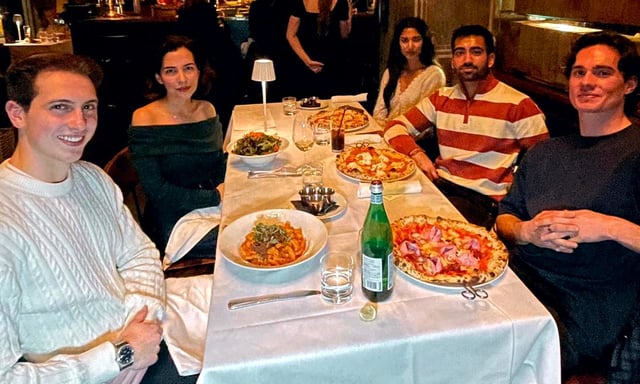
Timeleft is a dinner-with-strangers service. You subscribe, answer a personality quiz, and on a Wednesday it can seat you at a restaurant with a small group of people you have never met. It runs in hundreds of cities worldwide, and Vancouver is one of six Canadian cities on the list. The company is explicit that it is not a dating app and not a networking app. It exists to make big cities less lonely, and it takes that framing seriously.
That is worth knowing up front, because it decides whether Timeleft is the right thing for you or the wrong thing entirely.
How a Timeleft night actually works
The format is deliberately hands-off, and every part of it is designed to remove your ability to optimise.
You answer a short questionnaire at sign-up. Not a profile, a personality quiz. An algorithm then groups four to six people for a given Wednesday, weighing personality, age range and the language you want to speak. Small enough that one conversation can hold, big enough that a quiet person can sit out a round.
You do not pick the people or the restaurant. The venue and a short preview of the group arrive shortly before the night: the App Store listing says on the day, Timeleft's own blog says the day before, so treat it as late notice either way. That is the part most people either love or find genuinely stressful. It is a real commitment to a night you cannot research in advance.
Dinner runs around two hours. Afterwards some tables carry on to a nearby bar, which Timeleft nudges toward but does not organise for you. Whether that happens depends entirely on who is at your table.
What it costs, including the part people forget
Two separate costs, and the second one surprises people.
The subscription runs around twenty dollars a month, with lower effective rates on the three and six month plans. Canadian pricing shows in the app and moves with promotions, so check it rather than trusting any figure in a blog post, including this one.
What the subscription buys is the matching and the reservation. It does not buy dinner. You pay the restaurant directly for whatever you order, and Timeleft's own guidance puts a typical meal in the twenty to forty dollar range before alcohol. In Vancouver, once tax, tip and one drink are in, thirty to sixty dollars a head is the honest number.
So a monthly subscriber going to two dinners is realistically eighty to a hundred and forty dollars in for the month. That is not expensive for two nights out a month, but it is roughly triple what the sticker price suggests, and the cancellation experience has generated a steady stream of complaints. Cancel through the app rather than assuming a lapsed month cancels itself.
What people actually say about it
Reviews are genuinely polarised, and the pattern in them is consistent enough to be useful.
The most common complaint by a distance is the room. Timeleft books restaurants that are frequently too loud for a small group to hold one conversation, and reviewers across cities describe tables where they could not hear the person opposite. For a service whose entire product is conversation, that is the failure that matters most.
The second is matching. People answer the quiz, then describe a table that felt entirely random on age, life stage and interests. The algorithm is optimising for balance rather than similarity, which is a defensible choice, but it does not always land.
Third is billing. Unexpected renewals, and slow or absent responses to refund requests, come up often enough across independent review sites that you should treat the subscription as something you actively manage.
The positive reviews are real too, and they tend to describe the same thing: a table of people you would never have met, a couple of hours that went somewhere unexpected, and occasionally a friendship that outlasted the night. When Timeleft works, that is what it delivers. It is a lottery with decent odds, not a guarantee.
Who Timeleft is genuinely good for
New to Vancouver, and your only social circle is work. This is the strongest use case by far, and it is exactly who the product was built for.
Recently out of a long relationship, or coming out of a stretch where your world got small. Wednesday becomes a standing reason to leave the house that requires no organising from you.
Naturally curious about people, and comfortable with a night you cannot control. The randomness is the feature. If that idea sounds fun rather than exhausting, you will get your money's worth.
Vancouver has a reputation for being hard to make friends in as an adult, and Timeleft is an honest answer to that. Give it three or four dinners before you judge it, because a single bad table tells you nothing.
Where it falls short if you are a founder
If you are running a company, the mismatch is structural rather than a quality problem.
Timeleft matches for social balance, not for stage, industry or what you are working on. Across four to six people drawn from the whole city, the odds that anyone else is building something are low, and the odds that they are building at your stage are lower still. You will have a nice evening. You will not have the conversation you actually needed.
There is also nothing stopping the table becoming a de facto pitch, which the format is not designed to police. Founders often turn out to be the person who talks about work, in a room that came out to not talk about work.
None of that is a criticism of Timeleft. It is doing the job it says it does. It is a criticism of using it for a job it never claimed.
We wrote a longer comparison for founders weighing exactly this in our Timeleft alternative guide.
The other options in Vancouver
The dinner-with-strangers category has more than one entrant here now. Several apps run small-group dinners in Vancouver on per-event pricing rather than a subscription, which suits you better if you want to try one night without committing to a month. If you are comparing apps rather than clubs, our guide to the best apps to meet other founders in 2026 puts Timeleft beside X, LinkedIn, Luma and Meetup.
There is also a genuine local supper club scene that predates all of these, including a Vancouver dinner club running fifty dollar seats at hosted tables. Smaller, less algorithmic, and often better rooms for conversation than a booking made through an app.
And then there is the founder-specific version, which is what we do. Founder Feast seats a table of five every other Thursday at 7pm, in Vancouver, San Francisco and Los Angeles. Every person at the table has been through an application, you are matched on stage and industry rather than personality, and the guest list and restaurant land 24 hours before rather than shortly before the night. There is no pitching, which is the one rule, and membership is $39.99 CAD a month covering every dinner you book. You pay the restaurant for what you eat, the same as Timeleft.
Different product, different job. If you want friends, Timeleft is the better tool. If you want people who do what you do, start with our comparison of founder dinners and networking events.
Common questions
What night does Timeleft run in Vancouver? Wednesday for the standard dinner. Women-only dinners run on Tuesdays in the cities that offer them.
Can I go with a friend? The format is built around going alone, and turning up as a pair changes the dynamic at a small table. If you want to bring someone, a supper club or a per-event app is the better fit.
Do I have to drink? No, and the table cost drops a lot if you do not.
Is Timeleft safe? It is a public restaurant, a handful of other people and a booking under your name. Standard sensible precautions apply, and Vancouver's downtown and Mount Pleasant restaurant districts are well lit and busy on a Wednesday.
Related reading
- Timeleft in the other two cities we run in: San Francisco and Los Angeles.
- What an entrepreneur dinner club costs in 2026, if you want the curated version and the price of it.
- Vancouver entrepreneur networking, honestly assessed.
- How to host a founder dinner, if you would rather build the table than join one.
- The best apps to meet other founders in 2026, if you are choosing between apps.