Canada has hundreds of programmes calling themselves incubators, accelerators, hubs, studios, launchpads and labs. The words get used interchangeably, including by the programmes themselves, and the result is founders spending months in the wrong one.
The distinction is not marketing. It changes what you are expected to arrive with, what you give up, and what you leave holding. Get it wrong at the idea stage and you burn a year in a programme built for companies with revenue. Get it wrong with revenue and you sit through curriculum designed for people who have not shipped yet.
Here is the actual difference, the Canadian version of it, and how to work out which one you need.
The difference is the clock, not the prestige
Strip away the branding and three things separate them.
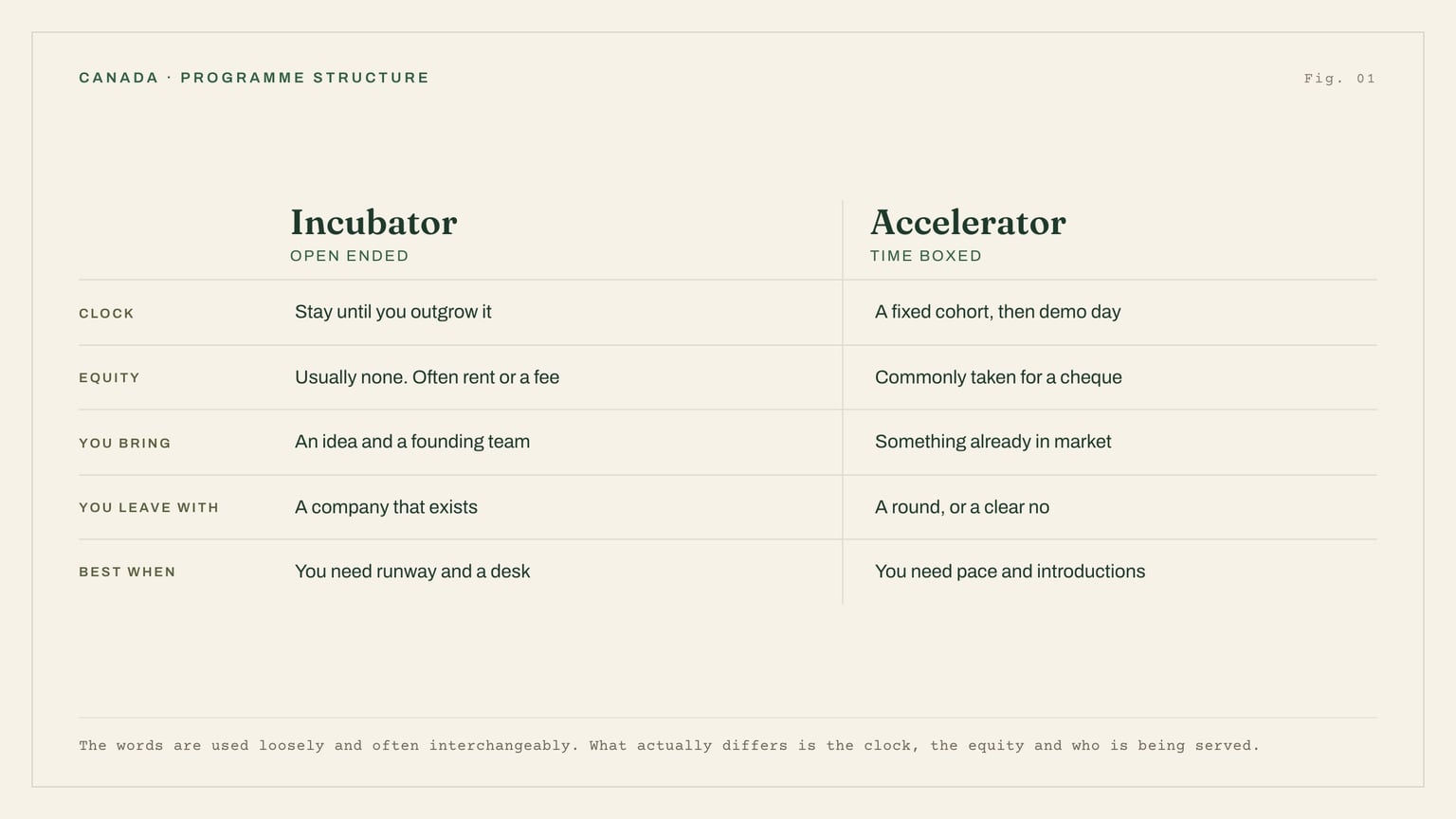
The clock. An accelerator is time-boxed. Three months, six months, a fixed cohort that starts and finishes together, usually ending in a demo day. An incubator is open-ended. You stay until you outgrow it, and there is no date forcing you out.
The equity. Accelerators have historically taken a slice, classically in exchange for a cheque. Incubators usually take nothing and charge you rent or a fee instead, or nothing at all when a university or a government is paying.
Who is being served. An accelerator wants companies that already work, so it can make them work faster. An incubator wants companies that do not exist yet, so it can help them exist. The verb is the whole thing. One accelerates, the other incubates.
Everything else follows. Demo day exists because accelerators need a moment where investors show up, which is only useful if you have something to show. Open-ended space exists because incubating takes as long as it takes.
The Canadian version is unusual, and it favours you
If you have read American advice on this, recalibrate. The classic accelerator trade, roughly $500K for seven percent, is a Y Combinator shape that barely exists in Canada.
Canada's leading programmes are largely university-embedded or government-funded. That changes their incentives completely. They are measured on companies created, jobs generated and follow-on capital attracted, not on fund returns. So they do not need your equity.
Creative Destruction Lab takes zero. MaRS takes zero in its programmes. Velocity at Waterloo takes zero. Next 36 dropped its 2.5 percent requirement in September 2025, and Next Canada says none of its programmes invest cash either. The DMZ Incubator is the exception worth knowing, at 2.5 percent common equity. The equity-for-cash accelerator has thinned out here, and what filled the space is programmes that want your time rather than your cap table, and mostly put in no money.
That is a genuinely better deal, with one catch. When a programme takes no equity, it has no financial stake in your outcome. The mentorship can be excellent and the accountability can still be soft, because nobody loses money if you drift. You have to supply the urgency yourself.
When an incubator is the right call
You need physical infrastructure. This is the strongest reason and the least discussed. If you are building hardware, semiconductors, biotech or anything requiring a lab, programme space is cheaper than anything you could rent and comes with equipment you could not buy. ventureLAB's hardware programme in York Region exists for exactly this.
You are pre-company and building alone. An incubator gives you a room, a schedule and other people at the same stage. If you have been building on evenings and weekends for eight months and losing steam, that structure is worth more than advice.
A grant or a visa requires affiliation. Several Canadian funding programmes and the startup visa route need a designated organisation behind you. In that case the programme is a means to a specific end, and you should pick on eligibility rather than vibe.
You have deep technical IP and no commercial instinct yet. Creative Destruction Lab is built for this. Nine months, no equity, no cash, and a room of scientists and investors who set you three objectives and judge whether you hit them. Founders do get dropped between sessions, which is the accountability the no-equity model usually lacks.
When an accelerator is the right call
You have something in market and it is working slowly. Accelerators compress. If you have paying customers and a repeatable motion, three months of pace and introductions can move you a year. If you have neither, there is nothing to compress.
You need a specific network you cannot reach. This is the honest reason most good accelerators are worth their terms. You are buying warm introductions to investors and customers who would not take your cold email.
You are raising in the next six months. A demo day is a forcing function and a deadline with an audience. That is genuinely useful when you were going to raise anyway, and actively harmful when you were not, because it pushes you to raise on the programme's schedule rather than your own.
You are in a sector with a specialist programme. A generalist cohort gives generic advice. If there is a programme for your exact sector, it beats a more prestigious general one nearly every time.
When the answer is neither
Nobody running a programme will tell you this, so here it is.
Skip both if what you actually need is customers. No incubator or accelerator will find them for you. They will fill your calendar with sessions, workshops and office hours that feel like progress and are not, and you will surface six months later with a better deck and the same revenue.
Skip both if you already have a network. The single biggest thing these programmes sell is access to people. If you have been in your industry for a decade and can call the people you need, you are paying in time and attention for something you already own.
And skip both if you are applying because you feel behind. Programme rejection and acceptance both feel like verdicts on you, and neither is. Plenty of very good Canadian companies never joined anything.
The Canadian incubators worth knowing
DMZ at Toronto Metropolitan University is the biggest by volume. Its Pre-Incubator takes idea-stage founders twice a year, and its Incubator takes seed-stage companies with recurring revenue on a rolling basis, for 2.5 percent common equity and no fees.
Creative Destruction Lab, with sites in Toronto, Vancouver, Montreal, Calgary and Halifax, for science-based companies with real technical IP. No fees, no equity, no cash.
MaRS Discovery District in Toronto, which is less a programme than an introduction layer between companies and capital. Its programmes take no equity; its evergreen fund, MaRS IAF, invests separately.
Velocity at the University of Waterloo, zero equity, with $5,000 and $25,000 pitch awards and a separate university-backed venture fund, Velocity Fund II.
ventureLAB in Markham, the serious hardware and semiconductor option in Ontario.
Communitech in Kitchener, whose Fierce Founders programme relaunched in 2026 for women and non-binary founders.
For the accelerator side, our 2026 comparison of Canadian accelerators covers cheques, equity and the next deadlines, and the Toronto-specific list sorts local programmes by stage. If you are in British Columbia, start with the BC startup ecosystem guide.
What no programme gives you
Both models give you mentors, and mentors are people who have opinions about your company but no stake in it. Both give you a cohort, and a cohort is a group you are quietly being ranked against.
What is missing from both is a small room of founders at roughly your stage who are not competing with you for the same demo day slot. That is where you find out what other people's numbers actually look like, which is the single most useful and least available piece of information in running a company.
Founder Feast is built around that gap. Five founders, one table, a restaurant we picked, matched on stage and industry, with the guest list revealed 24 hours before. No pitching, ever. Membership is $39.99 CAD a month and covers every dinner you book, in Vancouver, San Francisco and Los Angeles. It is not a substitute for a programme. It is the conversation the programme does not schedule.
Common questions
Can I do both? Sequentially, yes, and that is the common path. Incubator to get the company real, accelerator later to compress once it works. Simultaneously is a mistake. Both want your full attention and neither will get it.
Do accelerators still take equity in Canada? A few do, most of the well-known ones do not: the DMZ Incubator takes 2.5 percent, while Creative Destruction Lab, Velocity, District 3 and Next Canada take none. Always read the current terms rather than a list, because several programmes changed their terms in 2025.
Is a university programme worse than a private one? No, and in Canada it is often the opposite. University programmes have deeper research access, better space, and no pressure to generate a return from you.
How long should I stay in an incubator? Until it stops being the reason things are moving. The open-ended structure that makes incubators useful early is the same thing that lets founders stay a year too long.
Related reading
- 2026 Canada startup accelerators: the best, with deadlines.
- Raising pre-seed in Canada.
- Startup tax credits in Canada, the funding that needs no programme at all.