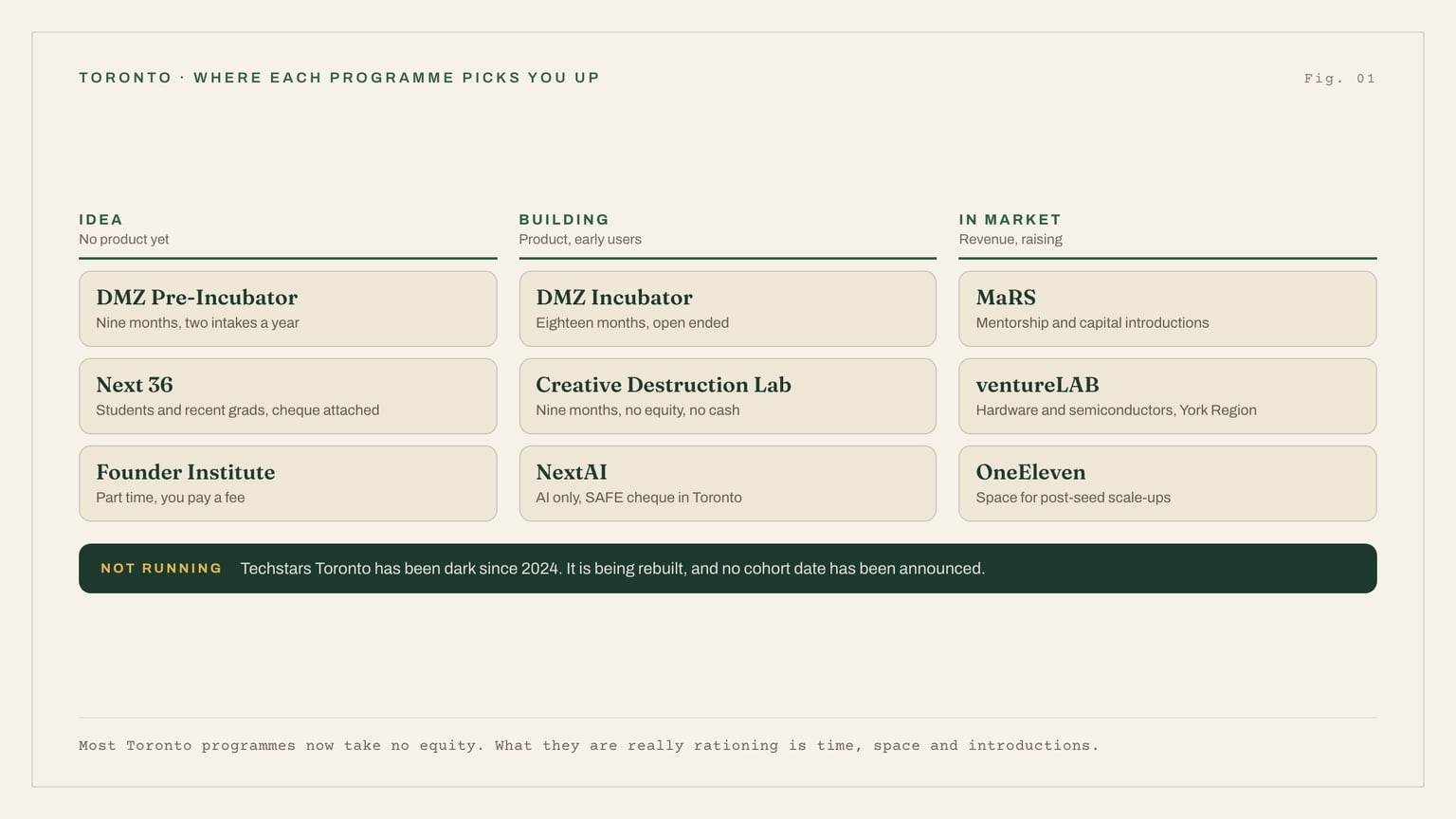
Most "top Toronto accelerators" lists you will find right now still tell you to apply to Techstars Toronto. That programme has been dark since 2024. Techstars has been quietly rebuilding it, recruiting a managing director and reworking the fund, but no cohort date has been announced and you cannot apply today.
That one detail tells you how much of the advice out there is copied rather than checked. Toronto's programme landscape moved a lot between 2024 and 2026: equity requirements got dropped, cohorts got smaller, and the centre of gravity shifted from cash-for-equity accelerators toward university and government-funded incubators that take nothing at all.
Here is the current list, organised the way you should actually think about it. Not by prestige, but by the stage each programme picks you up at.
Check that it is running before you check anything else
This sounds obvious. It is also the single most common way founders waste a month.
Canadian programme funding is heavily tied to government grants and university budgets, both of which move on cycles that have nothing to do with your fundraise. Programmes pause, rebrand, merge into their parent institution, or quietly stop taking applications while their website stays up looking perfectly healthy.
Before you write a word of an application, find the current cohort dates and the name of a human being running it. If you cannot find either, the programme is either between cycles or finished. Techstars Toronto is the loud example. There are quieter ones every year.
Idea stage: no product, maybe no company yet
DMZ Pre-Incubator at Toronto Metropolitan University runs nine months with two intakes a year, and it exists for people who have a direction rather than a product. The DMZ is the largest startup ecosystem in the city by volume and has supported north of 2,600 startups, so the network you are buying into is real even at the earliest tier.
Next 36 is the one worth knowing about if you are a student or a recent graduate. Eight months, part-time from January and full-time over the summer, 36 founders selected nationally, and up to $50,000 in seed capital during the programme. The important change: Next 36 removed its 2.5 percent equity requirement in September 2025. It now takes nothing. For a programme that hands you a cheque, that is close to unbeatable, and the selection bar reflects it.
Founder Institute Toronto runs four months part-time and is the odd one out, because you pay to attend rather than the other way round. It is open-admission in a way the others are not, which means you can get in with an idea and a job you have not quit yet. Treat it as a structured way to test whether you actually want to do this, not as a signal to investors.
Building: you have a product and early users
DMZ Incubator is the eighteen-month, open-ended version of the above. This is a genuine incubator rather than an accelerator: there is no demo day clock forcing you out, and you stay while you are still getting value. Best when you need space, a peer group and a reason to leave the house, and you are not yet raising.
Creative Destruction Lab at the Rotman School is the most misunderstood programme in Canada. Nine months, zero equity, and, crucially, zero cash. CDL does not invest in you. What it does is put you in a room with serious scientists and investors who set you three objectives, then judge whether you hit them. Founders get dropped between sessions. It is built for science-based and deep tech companies with real technical IP, and if that is not you, the mentors will not have much to say.
NextAI is the AI-only programme from the same organisation as Next 36. It runs roughly March to September, and the Toronto stream carries a SAFE cheque significantly larger than most Canadian programmes offer. If you are building an AI product and you are in Toronto, this is the one to weigh most carefully, because there is not a close second in the city for your sector.
In market: revenue, and a raise on the horizon
MaRS Discovery District is not really an accelerator and is better for it. It takes no equity, charges nothing, and functions as an introduction layer between growth-stage Canadian companies and capital. Its Capital Program relaunched in late 2025 with a smaller, more hands-on group of seed and Series A companies. If you are past product-market fit and your problem is investor access rather than advice, start here. Know who you want to meet before you ask: our map of the top Toronto VC firms in 2026 lists cheque sizes and sector focus for each one.
ventureLAB in Markham is the one founders in the city centre forget exists, and it is the only serious option in the region if you are building hardware. The Hardware Catalyst Initiative is aimed squarely at semiconductors and deep tech, with lab space that no downtown programme can match. Worth the drive up Highway 404.
OneEleven is a scale-up hub rather than a programme. No equity, no cohort, no curriculum. You rent space and get the network, and the alumni list runs through Wealthsimple, Clio, Koho and 1Password. Only relevant once you are post-seed and hiring quickly.
Waterloo is ninety minutes away and it counts
Toronto founders systematically under-use the Waterloo region, which is a mistake when the drive is shorter than a bad commute across the city.
Velocity at the University of Waterloo takes zero equity and runs its own pre-seed fund. Communitech in Kitchener relaunched its Fierce Founders programme in 2026 for women and non-binary founders, with one track built around getting companies to their first million in revenue.
Neither requires you to move. Both have deeper hardware and engineering talent pools than anything in Toronto proper.
Y Combinator is an option again, briefly worth mentioning
Y Combinator excluded Canadian-domiciled companies in late 2025 and reversed that decision in February 2026. Canadian companies can apply again.
Historically very few actually go, and the ones that do usually reincorporate in the US first. If that is your plan, read the Delaware flip guide before you decide, because doing it in the wrong order is expensive. Our Y Combinator Canada breakdown covers the application specifics.
What none of these programmes give you
Every programme on this list gives you mentors, a cohort and, sometimes, money. What almost none of them give you is a small room of founders at roughly your stage who have no reason to perform.
Cohorts are competitive by design. You are being ranked, whether or not anyone says so, and that changes what people tell you about their numbers. Demo day makes it worse. The honest conversation about churn, or a co-founder who is not working out, or the fact that last month was flat, tends to happen somewhere else entirely.
That is the gap Founder Feast fills. Five founders, one table, a restaurant we picked, and no pitching. Our tables run in Vancouver, San Francisco and Los Angeles rather than Toronto, so if you are reading this from Queen West, the practical move is to build the table yourself. We wrote up exactly how to host one, including the seating and the one rule that makes it work. It costs an evening and it outlasts most cohorts.
Common questions
Which Toronto programme should I apply to first? The one that matches your stage, not the one with the best-known name. A pre-product founder in CDL will get expensive silence from mentors who cannot help yet. A Series A company in a pre-incubator is wasting nine months.
Do I need to be a student for Next 36? It is aimed at undergraduates, master's students and recent graduates. If you are past that, look at NextAI or Next Founders from the same organisation instead.
Is it worth applying to several at once? Two or three that genuinely fit, yes. Applications are long and the reference checks overlap, so a scattergun approach reads as exactly what it is.
What replaced Techstars Toronto? Nothing directly. The equity-for-cash accelerator model thinned out in Canada, and what grew instead were zero-equity university and government programmes. If you specifically want a cheque with a cohort attached, NextAI is the closest Toronto equivalent.
Related reading
- Best Startup Accelerators in Canada (2026), the national picture beyond Toronto.
- Incubator vs Accelerator: which one Canadian founders actually need.
- Building a startup in Toronto, the wider city guide.
- Top Toronto VC firms backing Canadian startups in 2026, for when the problem is capital rather than curriculum.