If you're a Canadian SaaS founder pricing in CAD, you're probably leaving 15-25% of revenue on the table. Not because your product is underpriced, but because 70%+ of your pipeline is American and you're quoting them in a currency they don't think in.
The reflex is understandable. You incorporated in BC or Ontario, your bank account is at RBC, your payroll is in CAD, so pricing in CAD feels native. It isn't. It's a tax on your own growth, and in 2026 with FX swings running wider than they have in a decade, it's a tax that compounds.
Here's how to think about SaaS pricing Canadian startups actually face in 2026: what to price in, how to hedge, how to bill internationally without creating a compliance mess, and the specific traps that catch founders at Series A diligence.
Price in USD. Full stop.
If more than 30% of your customers are outside Canada, price your SaaS in USD. If you're pre-revenue and targeting any English-speaking market, price in USD from day one.
Three reasons this isn't optional anymore:
Benchmark gravity. Every comparable your prospects evaluate (HubSpot, Notion, Linear, Attio, Vanta) prices in USD. When your pricing page says "$49 CAD/month" an American buyer does mental math, lands on roughly $36 USD, and now you look cheap. Cheap reads as low-quality in B2B SaaS. You just lost the deal before the demo.
Valuation math. VCs model your ARR in USD. If you report $2M CAD ARR, a US investor sees $1.46M USD and prices your Series A accordingly. Founders who've gone through the Delaware flip learn this the hard way during diligence when the data room gets re-denominated.
FX asymmetry. Your costs are mostly CAD (salaries, rent, GST). Your TAM is mostly USD. Pricing in USD naturally hedges your P&L. When the loonie weakens, your revenue inflates in CAD terms while your costs stay flat. That's free margin.
The one exception: if you're selling to Canadian government, Canadian enterprise procurement, or regulated Canadian verticals (health, finance), run a CAD price list in parallel. Procurement teams will ask for it, and it removes a friction point.
Build an FX buffer into every CAD contract
For the Canadian contracts you do sign, bake a 5-8% FX cushion into the price. Here's why.
Your CAD-paying customer locks in a 12 or 24 month contract. During that term, the loonie can swing 10-15%. If you've priced razor-thin and the CAD drops, your USD-equivalent revenue craters while your AWS, Stripe, OpenAI, and Vercel bills (all USD) keep climbing. You're now funding growth with margin that disappeared.
Three practical moves:
- Price CAD contracts at roughly 1.40x your USD list price. Spot rate in 2026 has oscillated between 1.33 and 1.42. Pricing at 1.40 gives you headroom without looking gouge-y.
- Add an annual FX adjustment clause for multi-year deals. Standard language: "Pricing may be adjusted annually by up to 5% to reflect currency fluctuations." Enterprise buyers accept this. SMB rarely reads it.
- Hold operating USD at a US bank. Wise Business, Mercury (if you've flipped), or RBC's US cash management product. Converting USD revenue to CAD only when you need to pay CAD expenses is a free hedge.
Founders in the BC startup ecosystem who sell into the US and park revenue in a Mercury USD account are quietly running a better treasury operation than most Series B companies.
Structure international billing before you need to
The billing stack decisions you make at $100K ARR become the compliance nightmare at $5M ARR. Three questions decide everything:
Who is the merchant of record? If you use Stripe directly, you're the merchant of record. That means you're on the hook for sales tax, VAT, GST, and digital services tax in every jurisdiction where you have customers. In 2026, that list includes 40+ US states (economic nexus thresholds), the EU (VAT MOSS), the UK, Australia, and increasingly India and Brazil.
If you use a merchant of record like Paddle, Lemon Squeezy, or FastSpring, they handle all of that. They take 5-8% off the top. For companies under $3M ARR, the math almost always favors MoR. Your time is worth more than the 3% delta.
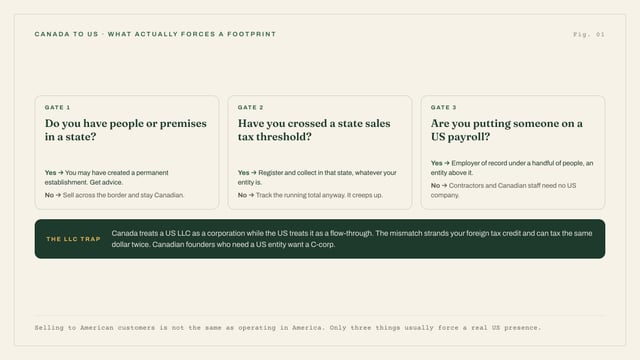
Where does revenue land? If you're still a Canadian CCPC, revenue lands in CAD at your Canadian bank, triggering GST/HST considerations on domestic sales and no sales tax on exports (zero-rated). If you've done a Delaware flip, revenue lands in your US subsidiary, which is now dealing with US state nexus. Talk to a startup lawyer who's done this before before you touch the structure.
How do you handle refunds and chargebacks? Build a 2-3% chargeback reserve into your pricing. Cross-border card fraud rates in 2026 are running higher than domestic, especially from LATAM and Southeast Asia traffic.
The CCPC vs C-Corp pricing question nobody warns you about
Here's a trap: as a Canadian CCPC selling SaaS to US customers, you qualify for SR&ED and the small business deduction, which keeps your effective tax rate around 12% on the first $500K of active business income. Beautiful.
But the moment your US revenue triggers permanent establishment rules (a US-based employee, a US office, consistent in-person US sales activity), the CRA and IRS start fighting over the same dollar. You can end up double-taxed, or spending $40-80K/year on cross-border accounting just to stay compliant.
Most Canadian SaaS founders doing >$1M USD ARR with US customers eventually face three choices:
- Stay CCPC, keep all employees in Canada, sell remotely only
- Flip to Delaware and accept the tax hit for easier US fundraising
- Dual-structure with a US subsidiary that handles US sales
The right answer depends on your fundraising path. If you're raising from US investors, they'll push you toward option 2 or 3 before leading a round. If you're bootstrapping or raising from Canadian angels, option 1 keeps your tax position cleaner.
The pricing implication: build your USD pricing with enough margin to absorb a potential 10-15% effective tax rate increase if you ever flip. Founders who priced at breakeven assuming CCPC rates get crushed post-flip.
Pricing tiers that work for cross-border SaaS
Specific advice, not theory. The tier structure that converts best for Canadian B2B SaaS selling into the US in 2026:
- Starter: $49-99 USD/month. Self-serve, credit card only, no sales touch. This is your PLG wedge.
- Growth: $299-799 USD/month. Annual billing preferred, invoice option available, light sales involvement.
- Business: $1,500-5,000 USD/month. Annual only, invoiced in USD, SOC 2 required, DPA on request.
- Enterprise: Custom. This is where you quote in local currency if asked. Procurement teams in Toronto, London, and Sydney often want local billing. Say yes, charge a 10% premium.
Avoid pricing in increments ending in CAD-feeling numbers like $65 or $130. American buyers subconsciously flag it as foreign-currency math. Use $49, $99, $299, $799.
Offer annual discounts of 15-20%, not 10%. The cash flow benefit of annual prepayment at Canadian startup stage (where every month of runway matters) is worth the discount. Founders building in Toronto running efficient annual-heavy motions have extended runway by 6-9 months on the same ARR as their monthly-heavy competitors.
What to pressure-test with other founders
Pricing is one of those decisions where reading blog posts (including this one) will only get you so far. The real intel comes from sitting across from another founder who repriced three months ago and seeing their actual conversion data.
That's the whole reason we started Founder Feast: five founders, one table, Thursday at 7pm, in Vancouver, Toronto, or Kelowna. No pitching. Just the conversations you can't have on LinkedIn, including the awkward ones about what you actually charge and what it did to your churn. If pricing is on your mind this quarter, apply for a seat.
Common questions
Should I show both CAD and USD on my pricing page? No. Pick one (USD if you're B2B global, CAD if you're Canada-only) and commit. Dual pricing pages confuse buyers and signal indecision. Offer CAD invoicing on request for Canadian customers at the enterprise tier only.
What's the right FX conversion cadence? Weekly batch conversions through Wise or your bank, with a floor rule: never convert if the rate is more than 2% below the trailing 30-day average. This smooths out volatility without requiring you to time the market.
Do I need to charge GST/HST to US customers? No. Sales of SaaS to non-residents are generally zero-rated for GST/HST purposes, meaning you charge 0% but can still claim input tax credits on your Canadian expenses. Keep clean records of customer location (billing address + IP) for CRA audits.
When should I hire a cross-border tax accountant? At $500K USD ARR or when you make your first US hire, whichever comes first. Budget $8-15K/year for a firm that actually understands SaaS and cross-border, not your cousin's general practice CPA.