Ask a founder who has been here two years to describe the Vancouver startup community and you will hear the same thing: it is small. They do not mean the number of companies. They mean the number of faces. The demo day, the pitch night, the accelerator showcase and the patio in August all hold the same fifty people, give or take, and you know most of them by name. Here is why that happens, where the founders you never see are, and what to do about it this month.
Why the Vancouver startup community feels like fifty people
Vancouver is a mid-sized ecosystem with a full-sized event calendar. There is something on nearly every weeknight, which sounds like abundance until you notice that the same calendar is filled by the same people.
The circuit is real, and it is not bad. Our guides to Vancouver tech meetups and Vancouver entrepreneurs groups exist because those rooms are worth knowing. The problem is that they all draw from the same pool: founders who read the same newsletters and are free on a Tuesday night downtown. That pool is a fraction of the founders in the city, and after a year of showing up you have met most of it.
So the feeling is accurate and misleading at once. You really have met everyone on the circuit. The circuit is not the community.
Where the founders you never see actually are
Mark where tech events happen on a map of Metro Vancouver and you get a tight cluster around Gastown, Yaletown and Mount Pleasant, where the coworking spaces and software offices are. Now mark where founders work, and most of those marks never come downtown for a mixer.
- Life sciences founders are in labs, not lounges. Vancouver has one of the largest life sciences clusters in the country, concentrated around the UBC campus and, increasingly, in the health and technology district in Surrey. These founders run on experiment schedules and grant cycles, and a pitch night about AI agents is not on their radar.
- Studio founders are in animation, visual effects and games. Vancouver holds one of the largest animation and visual effects clusters anywhere, alongside a deep games industry. The people who founded those studios, and the tools companies that serve them, go to industry screenings, not startup mixers.
- Hardware and cleantech founders are in Burnaby and North Vancouver. Fuel cells, power electronics and industrial equipment need loading docks, not hot desks, so those companies sit in the industrial areas east of the city and along the North Shore. Their founders rarely hear about a downtown founder event.
- Aviation founders are near the airport. Richmond has a working aviation sector around the airport: maintenance, parts, satellite and avionics work, and the training campus that feeds it. The founders there build serious companies and almost never appear on a startup panel.
- University spinouts are on campus until they are not. UBC and SFU both run programs that turn lab research into companies. The founders coming out of them are technical, early, and often unsure whether they count as founders yet. You will not meet them at a growth marketing meetup.
- Consumer founders do not call themselves startups. The food brand selling across the country online, the apparel company, the clinic chain and the production company are founder-run businesses with real revenue and no reason to attend anything with "tech" in the title.
Add them up and the picture inverts. The circuit you are tired of is a small, visible slice of a much larger and mostly invisible founder population. Our piece on building a startup in Vancouver covers where that community lives. The short version is that it lives at work.
Why volume events reproduce the loop
If the founders are out there, why does going to more events not fix it? Because the mechanism that fills a room is the same mechanism that filters it.
- Self-selection runs the door. An event is attended by the people who hear about it, through channels they are already in. The room is a mirror of the mailing list, and nobody at the lab in Surrey is on the mailing list.
- The topic is a filter. Put a sector in the event title and you have excluded everyone outside it before the first RSVP. An AI founders night will not contain a hydrogen founder. Volume events survive by being specific, and specificity keeps the loop closed.
- Scale trades depth for reach. A big room gives you thirty conversations of ninety seconds each. That is fine for hearing news and useless for turning a stranger into someone you would text at 11pm about a term sheet. So you drift back to the people you already know, because those are the only conversations that go past ninety seconds.
- The regulars become the room. Once a circuit has regulars, it optimizes for them, and a newcomer from an unfamiliar sector walks in, recognizes nobody, and does not come back.
None of this makes the events wrong. A big room is the right tool for hiring, for hearing who raised, and for finding a speaker. It is the wrong tool for meeting founders you cannot already name, which is why the city keeps feeling small as your calendar fills up. It is also, quietly, why founders here can be busy every night and still feel alone in it.
How curated seating across sectors breaks the loop
Every fix for the loop comes down to one change: someone other than you decides who is in the room. As long as you choose, you will choose what you know, which means your sector, your neighbourhood and your friends' friends.
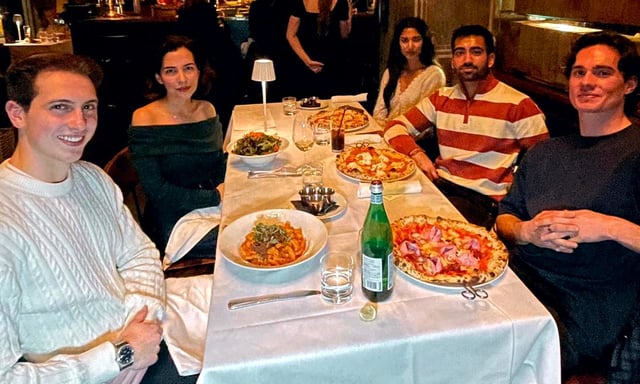
That is the design behind Founder Feast. Every Thursday at 7pm, five hand-picked founders sit at one table at a restaurant we choose. We build the table across sectors and stages, and we reveal the restaurant and the four other founders the day before. You do not choose your tablemates. The hardware founder from Burnaby, the consumer brand founder and the spinout founder still deciding whether to leave the lab end up at the same table, precisely because none of them would have picked each other.
Five is the largest group that can hold one conversation, and we wrote out the maths in why we only seat five founders per table. At five, everyone hears everything, and nobody spends the night next to the one person they already know, because there is nobody there they already know.
There are no panels, no badges and no pitches. Selling to the table gets you not invited back. The conversation usually lands somewhere none of you could have reached inside your own circle: the biotech founder's approach to regulators turns out to be exactly what the fintech founder needed to hear.
Membership is CA$39.99 a month and covers your seat at every weekly dinner. You pay the restaurant for what you eat on the night, and you can cancel anytime. You apply once, and every member is vetted before they sit down. The dinner is the main event, and the rest of the membership grows out of it: the hand-picked table, coffees, runs and hikes between dinners that are free to join, the directory and member-to-member chat with every other vetted member in the app, and perks kept for members. The app is on the iOS App Store and Google Play, and the same member area works on the web. For the full run of a Vancouver dinner night, read founder dinners in Vancouver.
Practical moves you can make this month
You do not have to wait for a Thursday to widen the circle. Here is what works, in rough order of effort.
- Write down your last ten founder conversations. Record the name, the sector and how you met. If eight of them are in your sector and all came from the same two channels, you have measured the loop.
- Go to one room that is not about you. Try a studio screening, a lab open house, a cleantech industry evening or a trade association breakfast in Richmond. You will be the odd one out, which is the point. Introduce yourself as a founder and ask what they are building.
- Change the question you ask for introductions. Asking who you should meet returns the circuit. Asking who they know who is building something nothing like yours returns the person you have never heard of. Put that question to the three most connected people you know and follow up on every name.
- Trade one mixer for one long conversation. Take the founder you find most unlike you for a coffee that lasts an hour. One real conversation moves you further than ten badge scans, and it tends to produce a second introduction on its own.
- Let someone else build the table. Apply to Founder Feast, and on Thursdays the table is chosen for you across sectors and stages. It is the one move on this list you cannot do yourself, which is exactly why it works.
Do those five and by the end of the month your list of founder conversations will look different: new sectors, new parts of the city, and people whose names you had to learn.
Common questions
Why does the Vancouver startup community feel so small? Vancouver is a mid-sized ecosystem with a full event calendar, so the founders who go to events keep meeting each other. Most founders in the city, in life sciences, cleantech, hardware, studios and consumer brands, rarely attend a tech mixer.
Where are the Vancouver founders who never show up at tech events? They are at work: in labs near UBC and in Surrey, in animation and visual effects studios, in hardware and cleantech companies in Burnaby and North Vancouver, in aviation businesses near the airport in Richmond, and in consumer companies that never call themselves startups.
How do I break out of the same circle of people in Vancouver? Change who decides the room. Go to rooms outside your sector, ask for introductions to founders nothing like you, and let someone else build the table. Founder Feast seats five vetted founders from different sectors every Thursday at 7pm, and you do not choose your tablemates.
How does Founder Feast work in Vancouver? You apply once and every member is vetted. Membership is CA$39.99 a month, covers your seat at every weekly Thursday dinner, and you can cancel anytime. You pay the restaurant for what you eat. The restaurant and your four tablemates are revealed the day before dinner.
Do I have to pitch at a Founder Feast dinner? No. There are no panels, no badges and no pitches. It is dinner with four other vetted founders, and selling to the table gets you not invited back.
Vancouver is not a small startup community. It has a small circuit, and the way out is to stop choosing your own room. Apply to Founder Feast once, get vetted, and sit down every Thursday with four founders you would not have found on your own.